

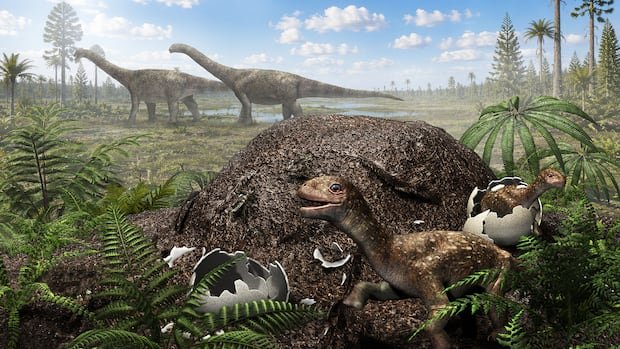

A recent discovery of ancient fossil eggshells from colossal dinosaurs suggests these creatures managed to hatch their offspring in a cool climate far from the equator without physically brooding over them. Researchers, led by University of Calgary paleontologist Darla Zelenitsky, in collaboration with experts from Japan and Argentina, conducted a detailed study on these titanosaurs’ eggshells. By analyzing the microscopic pores on the eggshells, the team concluded that titanosaurs likely utilized a similar incubation method to modern crocodiles, which involved burying the eggs in warm piles of decaying vegetation.
Titanosaurs, massive herbivorous dinosaurs weighing up to 75 tonnes, were a dominant presence in prehistoric times. These long-necked behemoths roamed the Earth during the Late Cretaceous period, coexisting with various other dinosaur species and wildlife in a rich coastal plain ecosystem. The discovery of volleyball-sized fossil eggs known as Fusioolithus associated with titanosaurs in the Chorrillo Formation in southern Argentina sheds light on the reproduction strategies of these ancient giants.
Despite their size, titanosaurs managed to adapt and thrive in diverse environments, including cooler regions like southern Argentina. The research highlights the innovative ways in which dinosaurs incubated their eggs to ensure successful hatching. While smaller dinosaurs relied on brooding their eggs for warmth, titanosaurs likely buried their eggs to maintain the necessary temperature for embryo development. The porous nature of the titanosaurs’ eggshells from the Chorrillo Formation indicates a burial incubation method, enabling the embryos to breathe while protected underground.
This groundbreaking study emphasizes the remarkable adaptability of dinosaurs, showcasing their ability to overcome environmental challenges and successfully reproduce in varying climates. The findings underscore the complexity of dinosaur nesting behaviors and raise intriguing questions about the evolution of reproductive strategies among different dinosaur species. Researchers believe that further exploration of titanosaurs’ nesting habits could provide valuable insights into their global distribution during the Late Cretaceous period.