

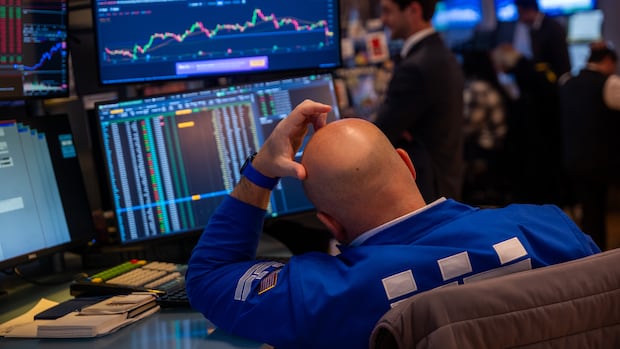

On Friday, a significant sell-off driven by technology hit North American stock markets, causing both U.S. and Canadian indices to plunge into correction territory, with substantial losses in artificial intelligence and technology shares.
The Nasdaq composite index, heavily weighted with tech stocks, wiped out all its gains for 2026, reversing a remarkable surge this year that had been fueled by investor excitement surrounding AI and the firms expected to drive its advancement.
Wall Street’s broader indices also experienced declines. The S&P 500, which serves as the benchmark for U.S. stocks, along with the Dow Jones Industrial Average—comprising 30 of the largest U.S. companies—have now entered correction territory, marking a drop of 10 percent or more from their recent highs.
The Nasdaq finished Friday down by 5.28 percent, marking its poorest week since April 2025. The S&P 500 closed with a decline of 3.7 percent.
The Dow Jones fell by 1.93 percent on Friday. The biggest losers included Nvidia, Goldman Sachs, and Caterpillar, while United Health, Walmart, and Johnson & Johnson saw notable gains.
In Toronto, the S&P/TSX composite index ended the trading day down 2.47 percent, also entering correction territory. Since achieving an all-time high in August, Canada’s benchmark stock index has decreased approximately 10 percent. This latest drop marked the TSX’s largest weekly decline since April 2025.
On Friday, the information technology and materials sectors led the TSX downward. Stocks such as BCE, Telus, and Quebecor made notable gains as investors responded to news regarding proposed mergers in Canada’s telecommunications industry.
On the Nasdaq, Anthropic saw a drop of 8.5 percent, a significant reversal from its strong market debut on Thursday. The firm, known for the popular Claude chatbot, was marketed to investors as a dedicated player in the AI surge.
Unlike other major AI firms like Google and Meta, Anthropic concentrates solely on the development and sale of AI models.
The company’s stock, listed on Nasdaq, ended its inaugural trading day on Thursday with a gain of 17 percent.
Recently, AI stocks have been under pressure, partly due to investor concerns that their market valuations and substantial expenditures may not be justifiable.
Tech analyst Dan Ives noted that the apprehension surrounding the current tech stock downturn resembles the levels observed during the COVID-19 pandemic and former President Donald Trump’s “Liberation Day” tariff announcement last year.
Ives highlighted a “perfect storm” of issues affecting the tech sector, including the leadership turmoil at Nvidia, U.S. regulators implementing stricter controls on AI chip access for China, and concerns over a slowdown in data center growth in the U.S. attributed to the recent Democratic victories in the midterm elections.
“This is a painful tech sell-off that heavily discounts the notion that the fourth Industrial Revolution will unfold over the coming years … and we believe that is a misjudgment,” he stated in a note to clients on Friday.

Anthropic made its public debut on Thursday, with a record-breaking IPO. While stock prices climbed as high as $111 US, the stock price fell to between $87 US to $89 US on Friday morning.
Nvidia was a major contributor to the market’s decline, dropping around six percent. On Friday, Reuters reported that U.S. financial regulators are investigating the chip maker’s accounting methods, according to two sources familiar with the situation.
Intel and SpaceX shares were also among the most significant decliners on the Nasdaq.
This recent tech sell-off has had a global impact, with Japan’s Nikkei and South Korea’s Kospi both falling by over five percent overnight. European markets also experienced sharp declines.