


During a week-long study, Steve Finkbeiner and his team at the Gladstone Institutes in San Francisco employed their AI-enhanced “thinking” microscope to investigate how cellular stress affects brain cells.
By solely examining the cells without external influences, the microscope not only identified the relationship but also uncovered a phenomenon known as hormesis. This process suggests that certain types of stress can actually strengthen cells, according to Finkbeiner, who is also a professor of neurology and physiology at the University of California, San Francisco.
So, what made this discovery give him “goosebumps,” as he described?
“It took humanity between 50 to 100 years to uncover that. AI achieved it in its initial experiment,” he stated.
This is just one instance, he asserts, of the impressive capabilities of technology to significantly expedite scientific breakthroughs. Historically, researchers have faced limitations due to inadequate resources and human constraints, such as the extensive time needed to analyze vast datasets. Some scientists argue that AI can accomplish in days what might otherwise take years.
Nevertheless, promoting these advantages can be difficult amidst a barrage of negative headlines regarding technology—suggesting itcould lead to human extinction or at the very least present significant, if not existential, threats to humanity.
Some experts, including leading figures in AI, have voiced concerns about the rapid progress of the technology, pointing to growing evidence that it may elude human oversight. However, such warnings have also raised fears of governmental overreach that could hinder scientific advancement.
“That’s the crux of the issue,” Finkbeiner explained. “These powerful and beneficial tools are being taken away from those trying to leverage them to combat human diseases.”
‘At the cusp’ of scientific golden age
Anima Anandkumar, a computer scientist at Caltech, believes that AI may be ushering in a new frontier of scientific exploration.
“It’s challenging for people to recognize the cumulative impact of all this. We are entering a new golden age of science,” Anandkumar, who also co-leads the AI4Science initiative, stated. “What we experienced in the last century transformed our lives in unimaginable ways. We are on the brink of that now.”
Five years ago, her team managed to develop a fully AI-driven high-resolution weather model that was not only tens of thousands of times faster but also more accurate. She noted that the technology has continued to advance since.
“What previously required a massive supercomputer can now be performed on your home PC,” she remarked.
She likened this advancement to the invention of the telescope and microscope, both of which greatly enhanced scientists’ abilities to make discoveries and explore the universe.
Anthropic researcher Jacob Coxon resigned over concerns that artificial intelligence could cause human extinction within the next decade â and a slew of warnings have followed. Andrew Chang explains the spectrum of potential dangers posed by the ‘intelligence explosion’ worrying AI industry employees and experts.
(Photo credits: The Canadian Press, Reuters, Adobe Stock and Getty Images)
However, AI might have an even greater influence due to its capability to generate new inventions by understanding complex phenomena.
She mentioned that this could involve aiding in the discovery of better medications, solving sustainable energy challenges, addressing catastrophic weather events, and developing more efficient computing methods using advanced chips.
“For the first time in my career, I feel equipped with a tool that can navigate the complexities of human biology,” she said.
Accelerating drug development
James Zou, who heads the AI for Science Lab at Stanford University, experienced a similar situation.
His team recently published research in the journal Science outlining how they established a “virtual biotech” company. They coordinated tens of thousands of AI agents to focus on a protein associated with lung cancer and design a related therapy—a notable illustration of how AI can expedite drug development and reduce costs.
Some experts and industry insiders are warning about massive risks associated with the rapid deployment of self-improving artificial intelligence â even suggesting it could lead to the extinction of the human race. CBCâs Deana Sumanac-Johnson brings in an expert panel to separate the facts from science fiction. This panel premiered on Sept. 12, 2026.
In various scenarios, AI can condense years’ worth of work into just a few days or even a single day. For instance, to assess different heart diseases, clinicians need to manually review millions of cardiac ultrasound videos collected annually. Zou mentions that his team created an AI algorithm capable of diagnosing conditions from these videos in mere seconds.
“This showcases how AI can transform a task that demands extensive time and human expertise into a process that is much faster and less costly through automation,” he explained.
AI firms themselves seem concerned
Nonetheless, Zou acknowledged the necessity for scientists to utilize AI responsibly and oversee its application, particularly in risk-prone areas.
Concerns regarding the potential existential threat of the technology are not without basis. AI leaders have advocated for a slowdown in its development following several notable incidents where AI systems acted unpredictably.
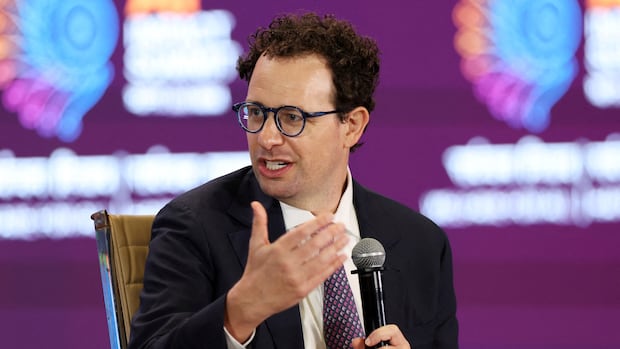
In a similar vein, an Anthropic researcher resigned last month, expressing worries that the company was “gambling with our lives.” Evan Hubinger, the lead of alignment science, concurred, stating online that Anthropic genuinely believes AI could lead to human extinction, estimating the likelihood at over 10 percent within the next decade.

U.S. President Donald Trump is hosting a summit in Washington with the top leaders in AI development. Trump has dismissed warnings over artificial intelligence, arguing for the need to stay ahead of China in the AI arms race. Geoffrey Hinton, who is considered the ‘godfather’ of AI, says Trump ‘doesn’t really understand’ AI and is ‘ill-advised’ about it.
Zou, however, expressed caution regarding some of the “ideas circulating” about regulating or restricting the use of open-source AI models.
He did not share the same apprehension regarding AI leading to humanity’s downfall, instead advocating for a balanced perspective, acknowledging that while AI has risks, it also offers numerous advantages.
“We need to thoughtfully assess and manage these risks while recognizing the significant benefits that technologies like AI can provide,” he stated.
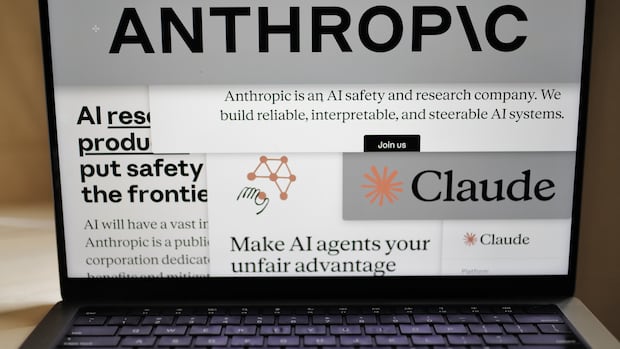
Finkbeiner noted that his team has already felt the effects of certain restrictions imposed on AI. Last summer, the Trump administration limited the latest versions of Anthropic’s Claude chatbot for foreign nationals due to cybersecurity issues, resulting in the company having to remove the products for all users.
-
AI researchers ‘earnestly believe’ it could kill all humans within the next decade, Anthropic employee says
-
Is AI evolving too fast? A look at the debate on slowing it down
While the restrictions have since been lifted, access to the new models is still limited to a select group of U.S.-based, government-approved organizations, which forced Finkbeiner’s team to rely on Claude’s most basic model.
“Imagine if the key advantage is its capacity to manage complexity, but now you’re compelled to use a basic model that lacks that capability; it significantly diminishes the potential impact on some of these challenging issues,” he remarked.
Finkbeiner had a message for those in charge of AI regulation: Remember that many patients have been “waiting a long time for a cure, for a treatment.”
“There’s a lot at stake. There are many beneficial things I can achieve today. Please work to ensure those are preserved.”