

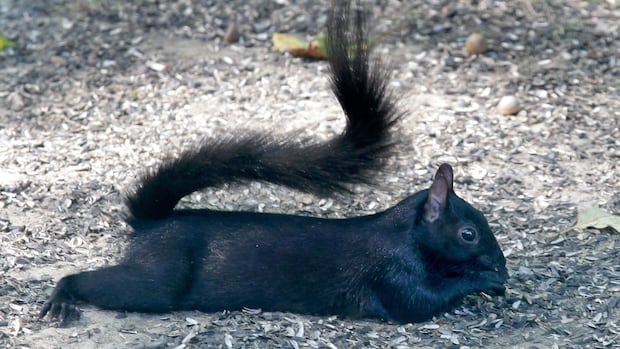

During his initial summer at McGill University, Francis Quang-Hai Dinh spent his time cycling around Montreal, on a quest to spot squirrels in various parks.
He rode to almost 200 green areas—from Mirabel to Saint-Bruno—while observing and documenting over 800 grey and black squirrels.
What began as a project for his undergraduate studies evolved into a personal endeavor aimed at understanding how the city’s design and meandering waterways are subtly influencing evolutionary processes.
“I developed a fondness for them after spending enough time observing and contemplating their behavior,” Dinh remarked. “People often overlook squirrels as mere nuisances, but they are truly part of the wildlife.”
Without access to a car and with limited public transport in suburban regions, Dinh depended on his bicycle to explore as far as he could, making him the only researcher known to have conducted a manual survey of squirrels from park to park throughout the area.
The prevalence of black squirrels in northern regions
He discovered that, on average, approximately 12 percent of Montreal’s squirrels are black. However, as he traveled further north, the proportion of black squirrels increased.
In regions just north of Laval, he observed that up to 40 percent of the squirrels were black—a term used to describe various darker fur coats that differ from the typical grey.
On Laval Island, around 20 percent were black, while on Montreal Island, the figure was about 15 percent. On the south shore of Montreal, the percentage plummeted to merely two or three percent, noted Dinh, who is currently pursuing integrative biology at the University of Illinois Urbana-Champaign.
The research identified three primary factors influencing this trend, with temperature being the most significant. Cooler northern climates are associated with a higher prevalence of black squirrels.
“Their black fur can absorb heat more effectively than the grey,” he explained.
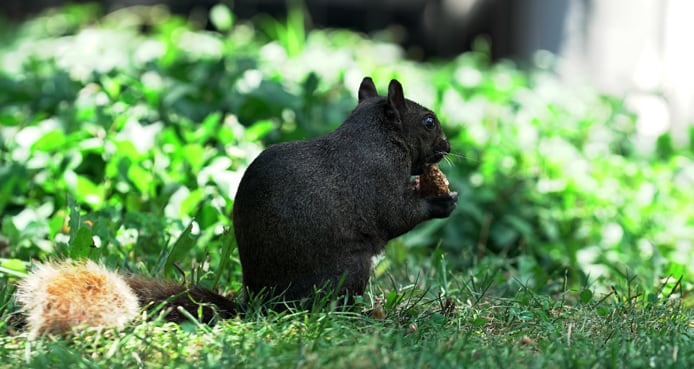
It is estimated that black squirrels, initially brought from Canada to Washington in 1902, now represent about half of the city’s squirrel population and have become a tourist draw. (Jason Lowther/CBC)
Additionally, this phenomenon is linked to tree coverage: a denser canopy provides a darker environment where black squirrels can blend in more effectively.
Squirrels as a model for evolutionary change
The lead author of the study, Allison Roth, an assistant professor at the University of Missouri and a former postdoc at McGill, stated that the research focuses less on the squirrels themselves and more on utilizing them as a model to examine how urban settings instigate evolutionary changes.
As Roth explains, cities are anything but uniform. The varying neighborhoods, differing levels of tree canopy, and distinct boundaries—such as Montreal’s waterways—create intricate environmental variations that can result in different genetic and physical adaptations within the same species.
“A unique aspect of Montreal is its segmentation by the St. Lawrence River and its tributaries, which is not common in many other North American cities,” Roth added.
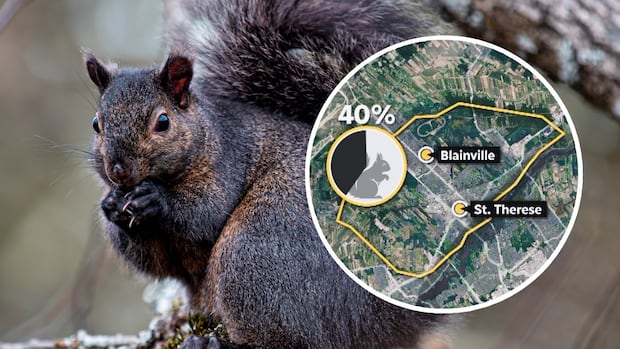
A new McGill study revealed that eastern grey squirrels in the city exhibit variations in coat color based on the neighborhoods they inhabit, influenced by local environmental factors such as temperature and tree cover.
“This creates distinct, small islands, and we might observe different patterns of squirrel melanism depending on whether these animals can traverse rivers or if they are isolated on these land masses,” she noted.
Understanding these dynamics is “crucial for grasping how evolution might take place,” she emphasized.
Urban environments are just one piece of the puzzle
The research, Fine-scale spatial variation in eastern grey squirrel melanism across a complex urban landscape, is available online.
While earlier studies typically compared urban wildlife to rural areas as a whole, this research focused on examining wildlife changes on a neighborhood-by-neighborhood basis.
Previously, researchers believed that human development was the primary influence behind these changes, but this study indicates that cities are just a part of the larger picture. Urban expansion alters local temperatures and reduces tree cover, while waterways serve as natural barriers.
“Urbanization does not directly determine melanism when local vegetation structure and winter microclimate are considered; rather, it influences melanism indirectly through various environmental factors,” the study concludes.
This research is part of a special feature being published by five ecological journals, focusing on how researchers utilize data and collaboration to address significant ecological challenges.
As for Dinh, he expressed that his perspective on wildlife has transformed.
“We often perceive city life and nature as entirely separate entities. Yet, the truth is that wildlife will continue to exist and adapt, regardless of the changes we impose,” he said.