

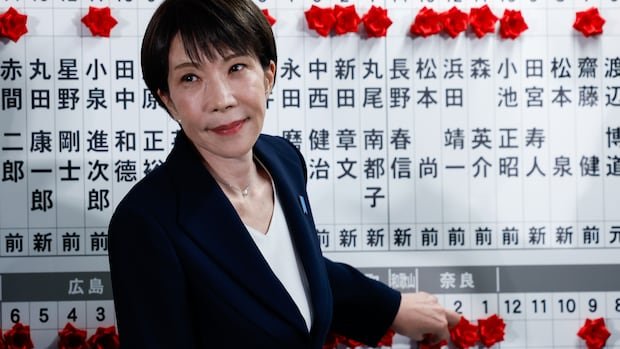

In a significant parliamentary election on Sunday, Prime Minister Sanae Takaichi’s ruling party achieved a resounding victory, securing a two-thirds supermajority, as reported by Japanese media based on initial results. Takaichi, in a televised interview with NHK, expressed her readiness to advance policies aimed at strengthening Japan’s position and fostering prosperity.
According to NHK, the Liberal Democratic Party (LDP) under Takaichi’s leadership independently captured 316 seats by early Monday, exceeding the 261-seat majority threshold in the 465-seat lower house, marking a historic achievement since the party’s inception in 1955. With an additional 36 seats secured by the Japan Innovation Party, the ruling coalition, led by Takaichi, now holds a total of 352 seats.
Following her landslide victory, Takaichi, with a smile, affixed a red ribbon above each winning candidate’s name at the LDP headquarters, amidst applause from party officials. Despite not holding a majority in the upper house, the significant increase in seats in the lower house positions Takaichi to advance her right-wing agenda focused on bolstering the economy and military capabilities in the face of escalating tensions with China and efforts to strengthen ties with the United States.
Acknowledging the need for opposition support, Takaichi emphasized her intention to drive forward policy objectives while remaining open to flexibility. The Prime Minister, known for her popularity, aims to address funding challenges and religious controversies that have plagued the LDP in recent years, having called for the early election to leverage her current favorability.
Takaichi’s push for a conservative shift aligns with her supporters’ preferences, particularly appealing to younger demographics previously disinterested in politics. Despite the opposition’s fragmentation, Takaichi’s strategic alliance with the Japan Innovation Party proved instrumental in securing a majority in the election.
The Prime Minister’s policy agenda includes enhancing Japan’s security and defense strategies, revising immigration policies, and increasing defense spending to meet international expectations, particularly under pressure from U.S. President Donald Trump. With a focus on economic measures, Takaichi aims to address cost escalations and wage stagnation, with forthcoming budget discussions post-election.
While Takaichi’s rightward stance may not drastically alter Japan’s foreign relations, concerns persist over potential revisions to the pacifist constitution and military buildup, especially in neighboring South Korea. As Takaichi charts her course for the future, the absence of elections until 2028 allows her ample time to pursue her policy objectives and navigate potential challenges.
As Takaichi looks to implement divisive policies, she faces scrutiny over the implications for civil liberties and diplomatic relations with China. With a strong mandate following the election, Takaichi’s leadership will be pivotal in shaping Japan’s trajectory on both domestic and international fronts.
The election day coincided with snowfall across Japan, including Tokyo, with reports of record snow in northern regions causing disruptions and fatalities, underscoring the broader challenges facing the nation amidst the political landscape.