

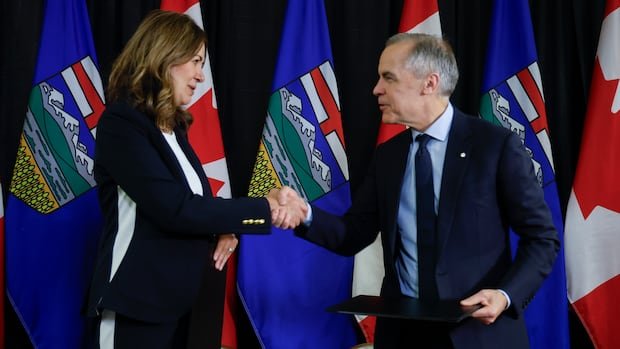

Ottawa’s clean electricity regulations in Alberta are on a countdown following the recent signing of a memorandum of understanding by Prime Minister Mark Carney and Alberta Premier Danielle Smith. The federal government has put a pause on the regulations designed to curb Canada’s top polluter without elaborating on how it plans to ensure the nation’s climate objectives are achieved. Carbon pricing is anticipated to have a significant role in this process.
The federal electricity regulations were anticipated to have a substantial impact in Alberta, potentially displacing around 214 million tonnes of pollution, equivalent to eradicating the emissions of over 49 million cars. Environment Minister Julie Dabrusin mentioned the possibility of negotiating a separate agreement with Alberta to achieve similar outcomes.
An equivalency agreement, authorized by the Canadian Environmental Protection Act, enables federal officials to engage in such agreements with provinces, territories, and Indigenous governments. Saskatchewan, Nova Scotia, British Columbia, and Alberta have all entered into such agreements with the federal government.
Under the recent agreement, Alberta has committed to achieving a net-zero power grid by 2050, aligning with the objectives outlined in the clean electricity regulations. Alberta has argued that these rules could compel them to phase out natural gas power generation, potentially leading to electricity shortages. However, the regulations do not outright ban natural gas power but require facilities to implement carbon capture and storage technologies and purchase carbon credits to offset emissions.
Alberta plans to reach its emissions targets through its Technology Innovation and Emissions Reduction (TIER) program, which regulates heavy electricity generation emitters. The agreement with Ottawa mandates Alberta to negotiate an increase in the price of carbon credits traded in the TIER system by April 1. The memorandum also commits to raising the province’s effective carbon price to a minimum of $130 per tonne.
Various organizations have differing opinions on the effectiveness of carbon pricing in achieving emissions goals. While the Canadian Climate Institute believes robust carbon pricing could be sufficient, the Pembina Institute is skeptical and emphasizes the importance of regulations in reducing energy emissions. The memorandum of understanding affirms that carbon pricing alone may not be adequate, and all possible measures will be considered before permanently suspending the clean electricity regulations.
The specific alternative measures to be implemented remain undisclosed at this time.