

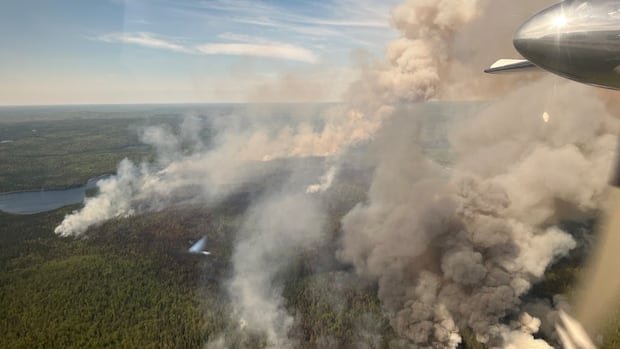

Amid Ontario’s unprecedented wildfire season, recent findings from McGill University confirm the protective role of aspen trees against fires. Flavie Pelletier, the lead author of a study, highlighted the resilience of aspen trees to fire, despite their thin bark. Through satellite imagery analysis of Canada’s boreal forest post-wildfires, Pelletier and her team observed that large patches of aspen can impede the spread of wildfires.
The research indicated that areas with extensive aspen coverage tended to be more resilient at the edges of fire-damaged regions. Aspen trees, with their higher moisture content in leaves and trunks compared to coniferous species like spruce and pine, are effective fire barriers. The positioning of aspen leaves higher on the trunk also hinders ground fires from easily spreading to other tree types.
Despite the protective benefits of aspen, Pelletier noted a concerning trend of reducing aspen populations in commercial forests. Forestry companies in Ontario regularly use glyphosate to eliminate broadleaf vegetation, which competes with commercially valuable coniferous trees. This practice, if continued extensively, could heighten the risk of wildfires in the long run, according to Pelletier.
While some studies suggest that broadleaf trees like aspen can regenerate after glyphosate spraying, the restoration process may take several years. Fred Pinto, a forestry expert, emphasized that only a small fraction of Ontario’s boreal forest undergoes harvesting each year, with limited evidence linking glyphosate spraying to increased wildfire vulnerability. He also noted that many ongoing fires in northern Ontario are in untouched, unsprayed areas, minimizing the immediate impact of glyphosate on wildfire risks.
Regarding concerns about the toxicity of wildfire smoke from glyphosate-treated forests, Pinto indicated that any residue in the air would likely be minimal and insignificant compared to the overall biomass. The intense heat of wildfires would likely eliminate any trace of glyphosate, making it challenging to detect in the air.
In conclusion, the study underscores the critical role of aspen trees in mitigating wildfire risks, urging a balanced approach in forest management to preserve these natural fire barriers.