

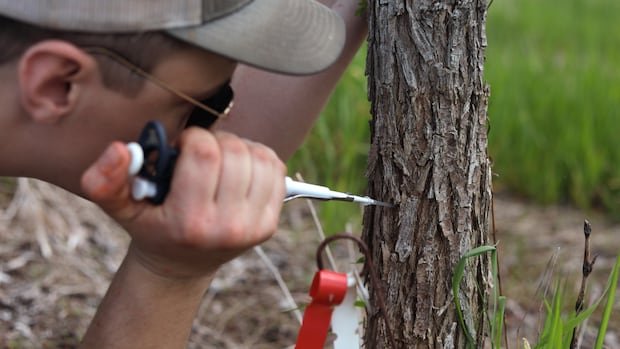

Throughout the summer, scientists in Vermont have been intentionally infecting thousands of trees with Dutch elm disease. The purpose of this unusual experiment, led by researchers from the U.S. Forest Service and the Nature Conservancy, is to test the resistance of a new generation of elms bred from survivors of the devastating disease that has plagued elm populations in the United States and Canada for many years. The ultimate goal is to eventually repopulate areas once abundant with majestic elms that lined city streets and flourished along riverbanks.
The significant decline in elm trees over the years has been described as devastating by Gus Goodwin, a senior conservation planner at The Nature Conservancy. The experiment aims to determine if these new elms could develop resistance to Dutch elm disease (DED).
In Canada, researchers are also engaged in similar efforts to combat the spread of Dutch elm disease, which is posing a growing threat to new regions.
The loss of thousands of elm trees in Fredericton, once famously known as the “City of Stately Elms,” during the 1960s and 70s due to the disease has left only about 1,000 mature elms remaining. Professor Anthony Taylor of the University of New Brunswick, who has surviving elms on his property, expressed sadness over witnessing another wave of the disease affecting trees in his woodlot.
Dutch elm disease, spread by bark beetles carrying fungal spores, attacks the vascular system of elms, disrupting water flow and eventually killing the tree within a few years of infection. To control the disease, infected elms are promptly removed, a practice known as “sanitization,” which involves eliminating the infected tree as well as nearby healthy ones, inadvertently reducing the population of disease-resistant trees.
The threat of Dutch elm disease has expanded to new regions like Edmonton and Saskatoon, where efforts are underway to combat the spread and protect the urban elm populations. The disease’s impact on mature trees goes beyond aesthetics, affecting their ecological roles in providing shade and managing stormwater runoff.
Researchers and foresters in North America are striving to enhance resilience against Dutch elm disease by breeding and cloning disease-resistant trees. The long-term goal is to reintroduce disease-resistant elms into communities to bolster biodiversity and adapt to the changing climate.
The experiment in Vermont involves injecting thousands of elm seedlings with fungus spores to identify those with resistance to Dutch elm disease. This meticulous breeding program, which involves multiple tree generations, requires time and patience to yield disease-resistant elms that can coexist with the fungus, much like elm species in Europe.