

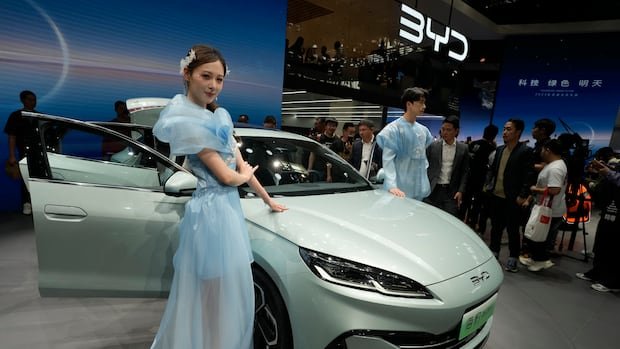

The electric vehicle sector in the nation is on the verge of a significant transformation. Prime Minister Mark Carney has decided to reintroduce Chinese-manufactured EVs into Canada, reducing a previously imposed 100% import tariff back in 2024 to a mere six percent.
The desire for more budget-friendly and eco-conscious EV options is growing. Max Morris, the sales manager at Shift Electric Vehicles in Burlington, Ont., noted that the presence of Chinese EVs in the market offers customers “more variety” and “advanced technology.”
While some individuals are welcoming the expansion of the EV market, others are expressing concerns regarding the safety and reliability of vehicles from companies associated with the Chinese government.
China has made waves in the global EV scene by providing affordable cars, SUVs, and other electric and hybrid vehicles. With over 100 EV brands, including dominant names like Geely, Chery, MG, Wulin, and Tesla, China has become a key player in the industry.
BYD, surpassing Tesla as the world’s leading EV seller, was aiming to enter the Canadian market before the steep tariff was implemented by former Prime Minister Justin Trudeau. Apart from China, BYD’s primary market is in Brazil, where it constitutes 80% of all EV sales.
Canada is set to welcome up to 49,000 Chinese EVs annually initially, which accounts for less than three percent of the total car market. This figure is expected to rise to around 70,000 over the next five years.
There is already a presence of Chinese EVs in Canada, such as those exported by Polestar and Volvo, both under the ownership of Geely, a Swedish company, as well as Tesla. The demand for more affordable Chinese vehicles in Canada appears to be substantial.
An Abacus Data poll indicated that a majority of Canadians favored a reduced tariff on Chinese EVs to enhance consumer affordability or the elimination of tariffs altogether.
While the exact timeline for the arrival of new Chinese EVs in Canada is unclear, Addisu Lashitew from McMaster University’s DeGroote School of Business suggests that vehicles could reach Canadian ports within a few weeks. Regulatory clearance and compliance procedures may pose challenges, but efforts to streamline these processes are crucial.
The affordability of Chinese EVs compared to other models may vary, with potential price advantages of $10,000 to $15,000 for Chinese EVs of similar size and range popular in the Canadian market.
Chinese EV brands may face pricing disadvantages due to the exclusion from the federal government’s consumer rebate for EVs produced by countries without a free-trade agreement with Canada, including China.
The introduction of Chinese EVs in Canada could prompt other automakers to lower prices, making EVs more accessible to consumers and aiding Canada in achieving its emission reduction goals. Maintaining safety and cybersecurity standards for Chinese-made vehicles will be a critical aspect of their market integration in Canada.