

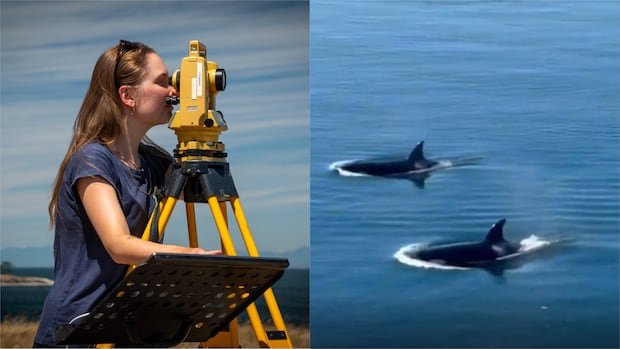

Whales are facing mortality in the waters of British Columbia due to various reasons, including collisions with vessels and disruptions in finding food caused by ship noise disturbances.
In recent incidents, a Sea-Doo struck a grey whale off Vancouver, a humpback whale was hit by a whale-watching boat, and another humpback was struck by a B.C. Ferries vessel, leading to tragic outcomes. These occurrences are on the rise and may escalate as ferry traffic surges and Canada intensifies shipping activities to Asia through those waters.
To address this issue, two British Columbia organizations are taking action. One initiative, called HALLO (Humans and Algorithms Listening for Orcas) led by Simon Fraser University, aims to mitigate ship noise to assist the endangered southern resident killer whales in locating food sources effectively. Lauren Laturnus, a biology master’s student at SFU, emphasizes the importance of protecting these whales as vital contributors to the ecosystem.
Using specialized equipment, Laturnus monitors whale movements in the Salish Sea while also observing vessel traffic from East Point on Saturna Island. The data collected helps in assessing the proximity of whales to large vessels, enabling timely reports to the Ocean Wise Whale Alert System for notifications to commercial mariners to adjust their speed or route.
Moreover, about 100 volunteer citizen scientists have been trained to track whale movements around Saturna, Pender, and Mayne Islands, contributing valuable information to the Whale Alert System. The collaborative efforts aim to create a safer environment for southern resident killer whales to feed without disturbances.
Southern resident orcas, classified as one of Canada’s most critically endangered marine mammals, heavily rely on chinook salmon, primarily found in the Salish Sea. The region serves as a crucial shipping passage, posing challenges to marine life survival.
In addition to HALLO, the W̱SÁNEĆ Marine Guardians, an Indigenous-led conservation initiative, play a vital role in monitoring and safeguarding marine ecosystems. By combining hydrophone recordings analysis and traditional knowledge, the Marine Guardians advocate for enhanced whale protection measures to the federal government.
A critical aspect highlighted by experts is the need for increased protections for humpback whales, as vessel strikes globally claim an estimated 20,000 whale lives annually. While some species have adapted to coexist with vessels, humpback whales face significant risks. Glenn Jones, founder of Reach Technologies Inc., has developed a multispectral camera system to detect objects, including whales, near vessels to prevent collisions and ensure marine life safety.
Jones envisions integrating this technology on commercial vessels and ferries to enhance whale detection and avoidance capabilities, ultimately fostering coexistence between marine life and maritime activities.
The collective efforts of researchers, citizen scientists, and technology innovators aim to safeguard marine life in British Columbia’s waters amid escalating shipping activities and growing threats to whale populations.