

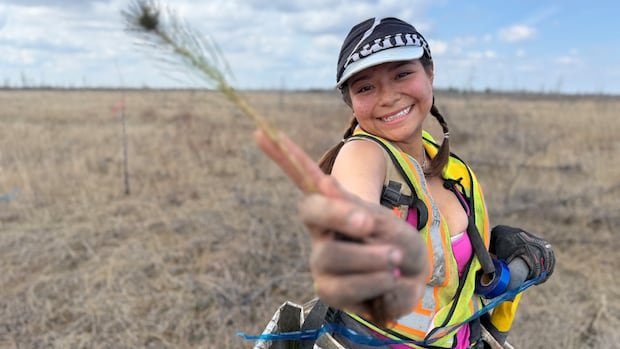

Marley Moose, a 22-year-old participant in a tree-planting crew in northern Manitoba, is dedicated to restoring forests ravaged by wildfires. Despite the cancellation of a federal initiative aiming to plant two billion trees by 2030, Moose remains committed to rejuvenating the scorched landscapes. She diligently plants jack pine and black spruce trees in areas once teeming with life that were reduced to ash.
In the Interlake region of Manitoba, a forest devastated by a jack pine budworm infestation in 2016 faced further destruction from a wildfire in 2021. As Moose and her team work to revitalize these areas, nearby regions are already experiencing fires this spring.
Moose, participating in a tree-planting program through Nekoté LP, an Indigenous-owned corporation representing Swampy Cree First Nations, emphasizes the importance of caring for the land. She believes in the reciprocal relationship between humans and the earth, highlighting the need to protect and nurture the environment.
The Canadian Tree Nursery Association (CTNA) reports that Canada is losing trees at a rapid pace due to various factors like development, logging, and wildfires. The cancellation of the 2 Billion Trees Program, a federal initiative introduced by former Prime Minister Justin Trudeau, poses a significant challenge to tree replacement efforts.
Doug Hevenor, the executive director of CTNA, expresses concerns over the impact of mega-fires on natural regeneration and the dwindling seed sources. With the cancellation of the program, initiatives like the Nekoté LP tree-planting project are at risk, jeopardizing the future of forest restoration efforts.
As Canada grapples with escalating wildfire seasons and carbon emissions from forest fires, stakeholders in the forestry industry are collaborating to find solutions following the discontinuation of the 2 Billion Trees program. Farron Sharp, a project manager with Blue-Green Planet Project, underscores the importance of sustainable tree-planting practices and seeks new funding sources to continue their mission of planting 20 million trees by 2030.
The tree-planting endeavor is seen as a vital countermeasure to environmental degradation caused by human activities. Sharp emphasizes the significance of reforestation in mitigating the impacts of climate change and unsustainable practices. Moose and her team persevere in their laborious task, driven by the hope that their efforts will preserve forests for future generations to enjoy.