

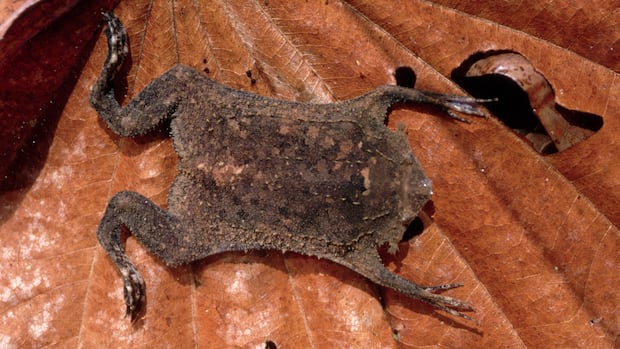


The Surinam toad is considered peculiar for a variety of reasons.
One notable aspect is its reproduction. Footage of this fully aquatic toad shows the young emerging from small openings in the skin on the mother’s back, fully formed.
Additionally, the toad itself has a distinctive appearance: it has a flat body, is nearly blind, lacks a tongue, and has small eyes situated on a triangular head. In the murky waters of the Amazon basin, its form can resemble a lifeless leaf resting on the riverbed.
Recent discoveries by scientists in California have revealed yet another remarkable trait of this extraordinary creature: the Surinam toad possesses the ability to ‘see’ using its fingertips.
For almost two centuries, researchers have been intrigued by how this toad effectively hunts despite its limited eyesight and the poor visibility of its environment. It can detect nearby prey and swiftly suck fish into its mouth in just a fraction of a second.
Measuring between 15-20 centimeters in width, with extended forelimbs, the toad remains motionless until a hapless fish comes too close. It then rapidly opens its jaws, generating a strong suction that draws the prey inside.
But how does it detect the fish’s presence?
In a recent study, Duncan Leitch, a neurobiologist at the University of California, Los Angeles, along with his team, discovered the answer: the frog — often referred to as the star-fingered toad — utilizes its fingertips to sense slight disturbances in the water caused by nearby prey.
“Frogs have four fingers on their forelimbs,” Leitch explained to Quirks and Quarks host Bob McDonald. “These [fingers] divide into four distinct lobes at each fingertip, and each lobe further divides four times in a fractal-like pattern.”
Published in the Journal of Comparative Physiology A, the new research has shown that these lobes are exceptionally sensitive touch receptors, functioning similarly to the fovea, a highly detailed area of sensors in the human eye. They are so sensitive that they can interpret signals from neurons to determine the size and distance of potential prey.
This allows the toad to draw in its prey even without physical contact, even in complete darkness.
“If a fish comes within half a centimeter to a centimeter of these frogs, they will initiate this ballistic suction feeding and completely inhale fish, worms, or anything that moves and stimulates the fingertips,” Leitch shared.
“Thus, it does not need to make direct contact with the fingertips themselves.”
What makes the fingertips so remarkable?
Utilizing a powerful microscope, Leitch and his colleagues discovered that each frog possesses 128 tiny lobes on its fingertips.
The skin on these lobes is equipped with four times as many dome-shaped bumps known as papillae compared to other areas of the fingers. These papillae enhance touch sensitivity, much like those on the human tongue.
“They are at least as sensitive as your own fingertips,” Leitch stated.
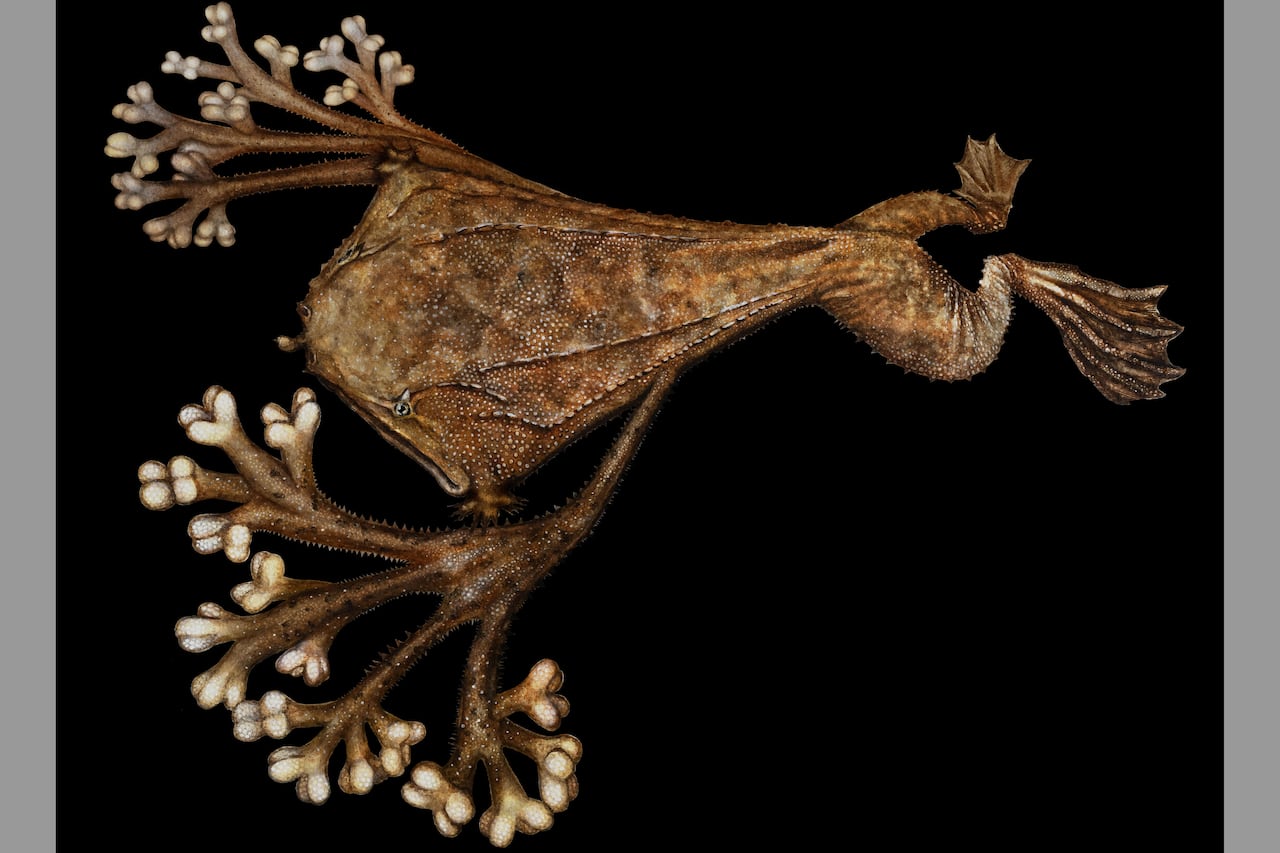
An illustration depicting a reimagined Surinam toad with toes proportioned according to their representation in the frog’s small brain. (Rebeca Fuquen/UCLA)
The study indicates that while the lobes represent only about eight percent of the skin on the frog’s forelimbs, they comprise approximately 60 percent of the touch-sensitive nerves in that region.
Researchers also found that the toad’s brain allocates significantly more space to the fingertips than one might expect given the frog’s small size. Despite the fingertips occupying a minimal portion of the body surface area, a disproportionately large area of the brain is dedicated to processing sensory inputs from them.
The significance of these findings
Lea Randall, a senior manager at the Wilder Institute in Calgary’s conservation program, highlights the importance of this discovery, as it represents a strategy previously thought to exist solely within the cortex of more advanced mammals, such as the star-nosed mole.
“Frogs lack the complex cortexes typical of most mammals, which means they have adapted other areas of their brain in the mid-brain region,” Randall, who was not part of the study, informed CBC.
The findings suggest that frogs and mammals, despite diverging in evolution for over 350 million years, have both reached a similar solution to an age-old challenge: when an animal requires extensive information from a small area of its body, it benefits from having numerous sensory receptors in that region along with substantial brain processing power.
“I believe these findings can enhance our understanding of how vertebrates have developed these systems,” Randall stated.
“Even in simpler vertebrates such as amphibians, where brain development is not as advanced, grasping how they have evolved to utilize different areas of their brain is truly fascinating.”