

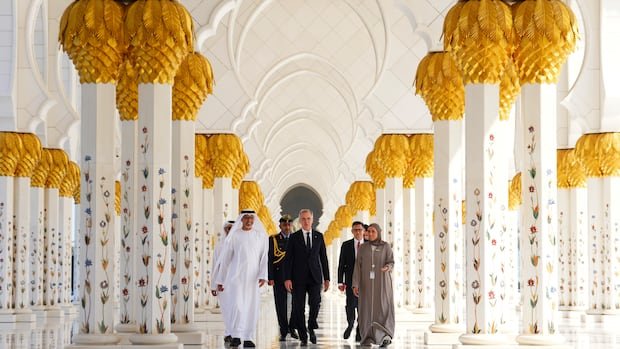

Prime Minister Mark Carney officially sealed an investment-protection deal with the United Arab Emirates on Thursday during his Abu Dhabi trip, which had restricted media coverage amid worries about the country’s potential involvement in fueling ethnic conflicts in Sudan.
Carney disclosed the investment agreement after a meeting with U.A.E. President Sheikh Mohamed bin Zayed Al Nahyan. They also initiated discussions on a comprehensive trade deal that aims to lead to a full-fledged economic partnership agreement eventually.
Earlier in the day, Carney engaged with Industry Minister Sultan Ahmed al-Jaber and later visited a grand mosque in Abu Dhabi. Subsequently, he held discussions with local sovereign wealth funds and investment entities like Mubadala, MGX, ADQ, and ADIC, before attending a dinner hosted by the U.A.E.’s national security adviser.
This visit occurred just a month after both nations inked a pact to enhance collaboration in artificial intelligence and data center operations.
Janice Stein, the founding director of the Munk School of Global Affairs at the University of Toronto, emphasized the U.A.E.’s emerging role in AI advancement and its potential to assist Canada through investments and innovation. She highlighted the U.A.E.’s significant strides in AI and expressed optimism for Carney’s early engagement with the country.
The U.A.E. leverages its affordable energy resources to support data centers, akin to how Canadian firms seek to utilize Alberta’s oilsands. The country aims to become a key player in the global AI-driven economy, with assurances from U.S. President Donald Trump on accessing cutting-edge American chip technology.
Former Quebec premier Jean Charest, who co-chairs the Canada-U.A.E. Business Council, anticipates a smooth transition to a comprehensive trade agreement with the U.A.E. due to Carney’s diplomatic efforts. Charest highlighted the existing substantial U.A.E. investments in major Canadian infrastructure projects and the U.A.E.’s aspiration to position itself as the financial hub of the Gulf region.
During his tour of the Sheikh Zayed Grand Mosque, Carney praised the architectural marvel, which incorporates materials sourced from various parts of the world, as a tribute to Emirati ingenuity and global collaboration.
Media access to Carney’s visit was restricted, without any scheduled news conference, reflecting the U.A.E.’s ongoing scrutiny over allegations of backing a militia involved in ethnic violence in Sudan, a claim vehemently denied by the U.A.E.
The civil war in Sudan involving the army and the Rapid Support Forces (RSF) has raised international concerns, with reports of ethnic atrocities committed by RSF members. Notwithstanding U.A.E.’s denial of arming the RSF, UN sources cite credible allegations to the contrary.
Stein highlighted the U.A.E.’s alleged role in the conflict, although she acknowledged recent peace efforts by Abu Dhabi, contrasting with the situation on the opposing side of the Sudanese civil war.
Carney is expected to address business leaders in South Africa following his engagements in the U.A.E. for the G20 leaders’ summit in Johannesburg.