

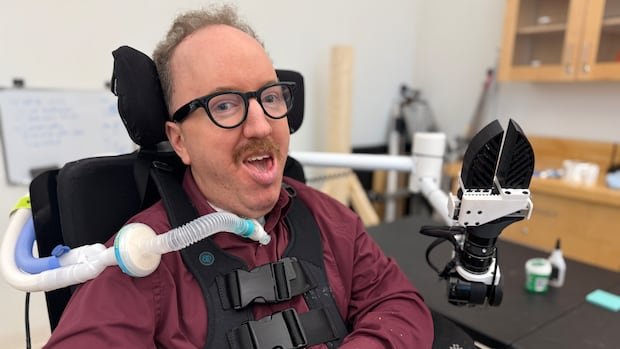

Hollis Pierce recently experienced a milestone moment by capturing his first selfie, surrounded by the innovative engineering team responsible for this achievement. Aged 38, Pierce, a staunch advocate for individuals with physical disabilities, holds the position of accessibility and partnerships head at Sielo Robotics, based in Ottawa.
At Sielo Robotics, his role involves testing products, notably the assistive robotic arm called Arlo. Pierce utilizes a space mouse, a versatile device enabling manipulation of 3D environments in six directions, to direct Arlo. Initially, the process of capturing a selfie with Arlo proved challenging, taking Pierce about an hour to master. However, with the latest fourth-generation model, the learning curve has significantly reduced, likened to playing a video game.
Pierce openly communicates feedback to his team, highlighting both positive features and areas needing improvement in Arlo. Sielo Robotics, originating from the University of Ottawa, prides itself on drawing inspiration from individuals with firsthand experience. Their progress is set to accelerate following a successful seed funding round in May, raising one million dollars.
The company remains housed within the University of Ottawa’s lab and has partnered with The 8-80 Collaborative, a joint initiative involving the CHEO Research Institute and Bruyère Health. To advance Arlo’s integration into households and communities, additional testers like Pierce are essential.
Pierce envisions Arlo as a groundbreaking solution, simplifying everyday tasks such as nose wiping or accessing water without complex assistance. Rafaël Hébert, the company’s chief technology officer, expresses optimism witnessing users like Pierce benefit from Arlo’s functionalities, attaining new levels of independence.
Overcoming the challenge of replicating intricate human actions in unanticipated settings is a primary focus for Sielo Robotics. User feedback plays a pivotal role, enabling the company to adapt technology to diverse control methods, ranging from eye gaze to joystick inputs.
Masoud Karimi, a robotics control engineer at Sielo, is developing an AI-driven system for Arlo to efficiently record routine tasks, aiding individuals with disabilities in performing complex activities independently. Sielo’s ultimate objective is to create a cost-effective device accessible through insurance coverage, a mission supported by the recent seed funding infusion.
Laila Burns, Sielo Robotics’ chief revenue officer, emphasizes the company’s dedication to affordability and accessibility, foreseeing Arlo’s deployment for beta testing in households by year-end. Pierce, in the lab, continues honing his selfie-taking skills with Arlo, enthusiastic about the device’s potential to empower future generations.
The prospect of making Arlo accessible to individuals with disabilities from a young age excites Pierce, underlining the transformative impact this technology could have on fostering independence and inclusivity.