

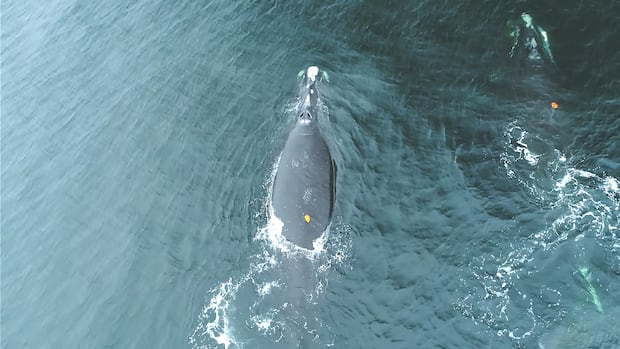

A recent investigation has revealed that critically endangered North Atlantic right whales are feeding nearer to the surface of the ocean during nighttime, raising their vulnerability to vessel strikes.
This research, which was published this month in the peer-reviewed journal PLOS One, recorded nighttime feeding habits of North Atlantic right whales, offering fresh evidence that could aid in mitigating lethal encounters between these whales and boats.
Jay Kirkham, the lead author of the study and a PhD candidate at Dalhousie University in Halifax, mentioned that the research team collaborated with the U.S.-based non-profit Ocean Alliance to tag 23 right whales in the Shediac Valley, an underwater valley located in the southern Gulf of St. Lawrence.
Each summer, a segment of the North Atlantic right whale population, estimated to be around 384 individuals, congregates in the Shediac Valley for feeding.
Kirkham explained that the tags captured video recordings as well as data on the whales’ movements and swimming directions.
He utilized video recordings to analyze right whale feeding behavior during daylight hours.
“When a right whale opens its mouth, it resembles a large parachute unfurling at the front of their face… and that significantly slows them down,” he explained. “As a result, they must exert more effort, which they accomplish by lifting and accelerating their tail.”
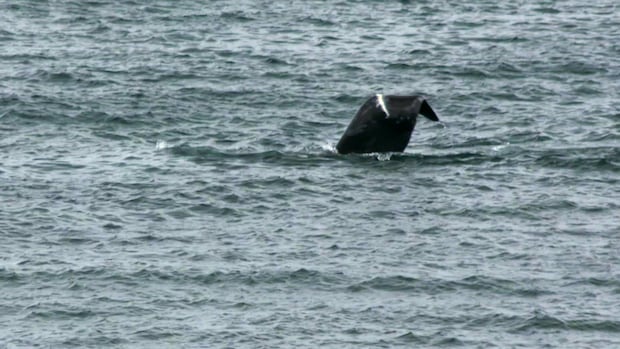
Videographers Heather MacAulay and Chris Murphy captured a remarkable image on Sept. 1 when they spotted a North Atlantic right whale near Blackhead Cove, N.L. Though the species is critically endangered, there are positive indicators suggesting that the population may be stabilizing.
Kirkham noted that he leveraged these observations to train a machine learning algorithm capable of identifying right whale feeding patterns during the night when visual confirmation was challenging.
The findings showed that the whales are feeding at depths similar to those of large vessels at night, thereby heightening the collision risk, he stated.
Although right whales usually feed near the ocean floor during the day, Kirkham indicated that they follow their prey—zooplankton—higher in the water column at night.
“These large ships that traverse the gulf extend into the water by about 10 to 15 meters,” he explained. “The whales are essentially overlapping vertically with that.”
He emphasized that vessel collisions and entanglements in fishing equipment are the primary threats to the population, and this study could contribute to improved conservation strategies for the whales.
Current protective measures for the population are overseen by Transport Canada and Fisheries and Oceans Canada.
Study can help inform protection measures: DFO
In a statement to The Canadian Press, Fisheries and Oceans Canada outlined that its measures aim to prevent whale entanglements in fishing gear and enforce seasonal fishing closures.
The department stated that the study could aid in formulating “tailored management measures to safeguard North Atlantic right whales.”
Transport Canada enforces speed limits and maintains a vessel exclusion zone in the Shediac Valley during summer months to minimize the chances of collisions between boats and right whales in that area.
However, Kirkham mentioned that the tagged whales spent roughly 25 percent of their feeding time outside this exclusion zone, which puts them at risk from ship traffic.
In a statement to The Canadian Press, Transport Canada revealed it has implemented a right whale monitoring program to protect the whales from collisions using both visual and acoustic detection methods.
“Acoustic monitoring systems and other complementary technologies can assist in detecting whales regardless of daylight conditions and inform protective actions when whales are present,” the statement noted.
The department also mentioned that it considers the latest scientific research, monitoring data, and input from stakeholders to guide its protective measures.
MORE TOP STORIES
-
This tiny N.S. community was frustrated with big-box grocers. So they opened their own store
-
CBC Investigates
Fear, sadness, and anger: Why children in N.S. government care frequently go missing
-
Video
Wabanaki reclaim land from United Church
-
Health-care professionals call on province to recognize obesity as chronic condition
-
Could a single Maritime power grid make electricity more reliable?