


In April 2024, the highly anticipated celestial event was the total solar eclipse visible in Eastern Canada and the U.S. The next excitement was the potential emergence of a new star in the sky known as T Coronae Borealis, or T Cor Bor for short. This star, while existing, was predicted to become visible to the naked eye by the end of the year but unfortunately did not manifest as expected.
According to Brian Kloppenborg, an astrophysicist and executive director of the American Association of Variable Star Observers (AAVSO), the uncertainty surrounding the physics of the T Cor Bor system has been a persistent challenge despite years of study.
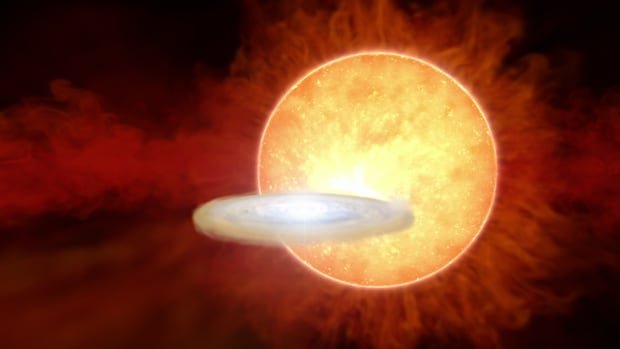
T Cor Bor is situated around 3,000 light years away and is part of a binary system within the Corona Borealis constellation, consisting of a large red giant and a small dense white dwarf. The interaction between these stars involves material transfer from the red giant to the white dwarf, leading to a buildup that culminates in a thermonuclear explosion, or nova, resulting in the star becoming visible to the naked eye.
Historically, T Cor Bor has exhibited cycles of high and low activity, with predictions of eruptions following quivers in the light curve. The most recent eruption occurred in 1946, with expectations of a new eruption since approximately 2014, hence the 2024 anticipation.
Research indicates varying forecasts for the eruption date, with some suggesting it could happen imminently, potentially within the current week. Publications from the American Astronomical Society and the journal Astronomy & Astrophysics have proposed different eruption dates, with some discrepancies in the predicted cycle timing.
Despite the delayed eruption, interest from amateur astronomers remains high, with continuous observations and data contributions aiding in the monitoring of T Cor Bor. When the eruption eventually occurs, the star is expected to brighten significantly for a brief period before returning to its previous state.
The astronomical community continues to monitor T Cor Bor closely, poised for the anticipated eruption that could happen at any time, as the star approaches the trigger level for the next nova event.