

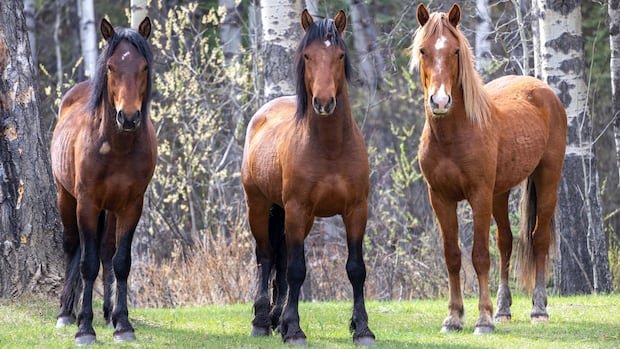

Health Canada has given the green light for a birth control vaccine to be trialed on free-roaming horses in Alberta. The Alberta government has raised concerns over the escalating horse populations in certain regions, deeming them “unacceptable” due to potential adverse effects on grazing lands for cattle and wildlife. To address this issue, the province has identified contraception as a key component in its feral horse management framework, alongside options like removal from the wild and adoption.
In late August, Health Canada granted a “research authorization” for the utilization of the contraceptive vaccine SpayVac-Equid, according to a spokesperson from the agency. This authorization permits the study of the product in feral horses, but does not constitute broad approval for its general use.
The Alberta government is currently scrutinizing the specifics of the approval for horse contraception. They emphasize a collaborative effort with stakeholders and advisory committees to implement management strategies in a humane and scientifically sound manner. Present actions are primarily focused on data collection and adoption initiatives.
The most recent feral horse survey in Alberta identified a record 2,072 wild horses across six equine management zones, with populations in certain areas deemed unsustainable. The government views these horses more as stray animals than wildlife.
In a bid to build on past initiatives, the province and the Wild Horses of Alberta Society initiated a contraception pilot project in 2014 to evaluate its effectiveness in population control. The project involved administering a vaccine named ZonaStat-H via darts to wild horses. Subsequent research revealed challenges, including high costs and terrain-related difficulties in administering booster shots.
The new strategy proposed by the Wild Horses of Alberta Society involves capturing horses, administering the vaccine manually, and releasing them back into the wild with markings for identification. This approach boasts a success rate of 85 to 95 percent, prevents conception for several years, and maintains herd dynamics. Unlike previous methods, the SpayVac-Equid vaccine does not necessitate booster shots.
The Wild Horses of Alberta Society aims to kick off the contraception project in the fall as part of an updated population control plan, which may also involve capturing select young stallions and relocating them from the wild. The society also engages in rescuing and rehabilitating horses, offering them for adoption to ensure their welfare.
This proactive approach seeks to strike a balance between managing horse populations and meeting the needs of various land users, as stated by Jack Nichol, the president of the Wild Horses of Alberta Society.