

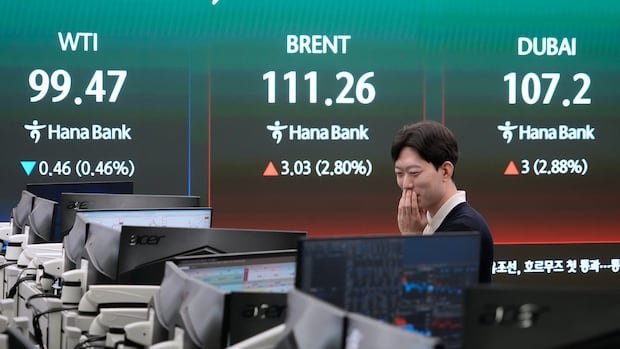

The value of Brent crude oil briefly climbed above $126 US per barrel early on Thursday due to stalled negotiations between the U.S. and Iran, casting uncertainty on the reopening of the Strait of Hormuz and a lasting resolution to the Iran conflict.
Brent crude scheduled for delivery in June saw a 3.3% increase to $121.90 after briefly exceeding $126 per barrel, marking the highest level since March 2022. Additionally, Brent set for delivery in July rose by 1.4% to $112.02. Prior to the onset of the conflict in late February, Brent crude was trading at approximately $70 per barrel. Meanwhile, benchmark U.S. crude rose by 1.3% on Thursday to $108.28 per barrel.
The escalation of tensions has led to a blockade of Iranian ports by the U.S., causing a surge in oil prices. Reports on Thursday hinted at a potential escalation by U.S. President Donald Trump, dimming hopes for a speedy resolution to the conflict. According to ING Bank strategists Warren Patterson and Ewa Manthey, the breakdown in talks between the U.S. and Iran, coupled with President Trump’s reported dismissal of Iran’s proposal regarding the Strait of Hormuz, has dampened expectations for a swift resumption of oil supplies.
The U.S. enforced a blockade after Iran effectively closed off the Strait of Hormuz, a crucial waterway through which around 20% of the world’s oil used to flow from producers in the Persian Gulf to customers. The surge in oil prices has swiftly translated into higher prices at gas stations and for jet fuel, with varying impacts based on exposure to energy flows through the strait. In the U.S., gas prices are currently lower than pre-war levels.
The spike in oil prices contributed to an uptick in inflation across Europe in April. Annual inflation in the eurozone, comprising 21 countries, rose to 3.0% from 2.6% in March, primarily driven by a 10.9% surge in energy prices, as reported by the European Union statistical agency Eurostat on Thursday. Conversely, euro-area growth for the first quarter of the year showed a minimal increase of 0.1% compared to the previous quarter.
If the Strait of Hormuz remains disrupted for another month, it is likely to trigger at least a technical recession in the eurozone, according to ING’s head of global macro Carsten Brzeski. Oil prices fluctuate based on the type of crude, trading location, and contract terms. By certain measures, Brent has reached its highest level since hitting $147.50 per barrel in 2008 during the global financial crisis.
The ongoing conflict has roiled global markets, leading to a decline in the U.S. dollar to 160.02 Japanese yen after reaching its highest level in nearly two years earlier on Thursday. The dollar has strengthened against other major currencies, partly due to its safe-haven status for investors during times of uncertainty and because of relatively higher U.S. interest rates as the Federal Reserve aims to balance economic stimulus with inflation control resulting from the conflict. The Federal Reserve’s decision to maintain interest rates at its recent policy meeting further bolstered the dollar.