

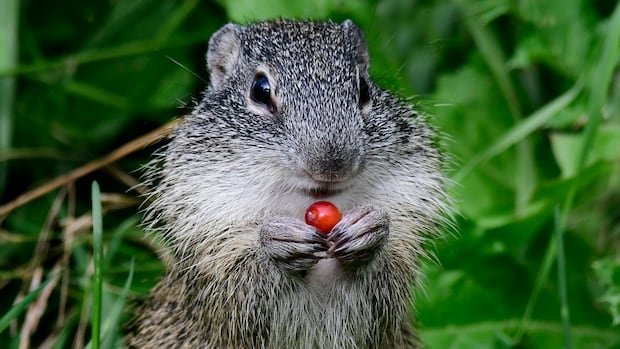

Scientists are urging residents of Alberta to be on the lookout for a rare type of rodent. The elusive Franklin’s ground squirrel is the focal point of a research initiative led by wildlife biologist Jess Haines in collaboration with conservation group Nature Alberta. The project was initiated due to observations by local naturalists indicating a decline in the squirrel’s population without any ongoing research.
The primary goal of the project is to demonstrate the decline in the Franklin’s ground squirrel population. Currently, the species is classified as “undetermined” by the Alberta government due to insufficient data. Changing this undetermined status requires a comprehensive process, according to Haines.
Unlike Richardson’s ground squirrels, which thrive in human-altered environments like pastures and golf courses, Franklin’s ground squirrels depend strictly on natural habitats with dense brush and forested areas. The conversion of these natural lands for agriculture and urban development has directly contributed to the dwindling numbers of the once widespread squirrel species.
The project led by Haines aims to gather sufficient data on the population trends of Franklin’s ground squirrels to push for a status change to “at-risk.” Historical sightings confirm that the squirrels were once prevalent across central Alberta, extending into the southern boreal regions and possibly the foothills, but are now restricted to a few remaining populations.
Haines emphasized that Franklin’s ground squirrels exist in lower numbers and densities compared to other ground squirrel species, making them more susceptible to local extinctions. The ongoing project involves fieldwork where the team, including Haines’ students, captures and releases the squirrels for research purposes. Additionally, the project encourages public participation by submitting historical and current observations of Franklin’s ground squirrels through platforms like iNaturalist.
By tracking historical and current sightings, researchers aim to map the past and present distribution of the species within the province. The project, which focuses on various aspects such as diet and habitat, does not have a specified end date but evolves its priorities periodically to address critical concerns.
Myrna Pearman from the Red Deer River Naturalists expressed her affection for Franklin’s ground squirrels and their docile nature. She joined Haines in the field to photograph the squirrels, hoping to raise awareness and protection for the species from the provincial government. The distinct features of Franklin’s ground squirrels, including a grey head and long bushy tail, set them apart from other squirrel species in Alberta.
Currently, no squirrel species are classified as at-risk in Alberta. The concerted efforts of researchers, naturalists, and the public play a crucial role in monitoring and safeguarding the unique Franklin’s ground squirrel population in the province.