

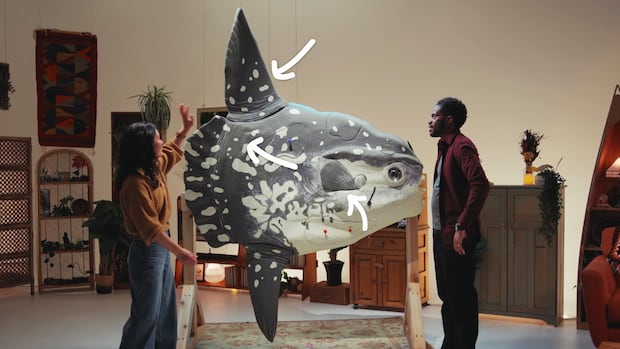

The term “ocean sunfish” may not conjure images of a creature that can weigh up to two tonnes and harbors parasites — even on its eyes.
In the show The Nature of Things 101, host Sarika Cullis-Suzuki explores what could be considered the most peculiar fish in the world.
“What fascinates me about this fish is that it represents everything we don’t expect a fish to be,” she explains. “It has this enormous circular body, lacks a tail, and possesses these massive fins.”
With the help of a life-sized model, Cullis-Suzuki demonstrates to co-host Anthony Morgan why the Mola mola — a species of ocean sunfish and one of the largest fish in the ocean — is often underestimated.
These fish are known for their extensive travels, diving hundreds of meters deep multiple times daily in search of food. However, Cullis-Suzuki points out that their slow movements, large surface area, and passage through various water layers make them appealing to parasites.
“This fish is infested with parasites: on its skin, in the gills, on the fins, on the eyeballs, inside the mouth, and in the intestines,” she states. “You get the idea — they are everywhere…”
“Researchers have identified 73 different species of parasites [on the Mola mola and other ocean sunfish]. Some of these parasites even have their own parasites.”
So, how does the sunfish manage to rid itself of these parasites?
“One method they employ is breaching — that is, they leap out of the water and then crash back down,” explains Cullis-Suzuki. “It is believed that this may help in getting rid of parasites.”
They also permit smaller fish and birds to feast on the parasites.
Yet, despite the knowledge we have about the ocean sunfish, it remains a species that requires further investigation.
“There is still a vast amount more to discover,” says Cullis-Suzuki.
Catch The Nature of Things 101 on CBC Gem and visit the The Nature of Things YouTube channel.