


Parts of British Columbia are experiencing severe drought conditions this summer, impacting various watersheds. Bessette Creek recently imposed water restrictions to safeguard salmon populations from critically low water levels. Additionally, temporary protection orders were issued for the Salmon River watershed in response to increased wildfire risks, with subsequent reissuances.
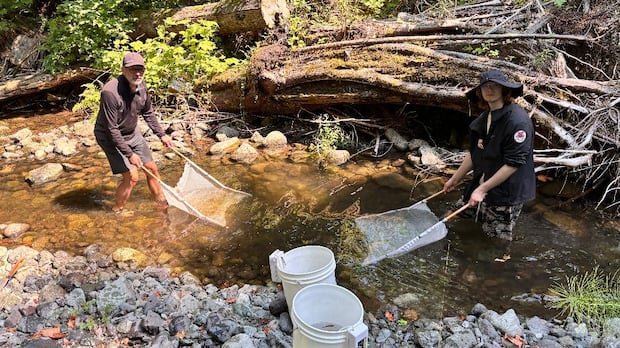
The Cowichan Lake Salmonid Enhancement Society in Vancouver Island, led by treasurer Bob Crandall, is actively involved in protecting 16 streams connected to Lake Cowichan as they progressively dry up each year. The society conducts fry salvage operations, manually rescuing fish from drying rivers and relocating them to other water bodies to mitigate the effects of diminishing water sources.
While communities in British Columbia appreciate these efforts, scientists caution that such interventions have limitations and may not provide a sustainable long-term solution. Collaborating with the Ts’uubaa-asatx Nation and volunteers, Crandall’s team focuses on relocating various fish species, including salmon, trout, and char, to areas with more water resources.
However, the changing climate presents challenges, making the relocation process more arduous. Crandall notes that streams are drying up farther upstream than before, necessitating increased effort in fish relocation activities. The logistics involve using aerators, bubblers, and nets to transport the fish safely, despite facing obstacles like traversing dry streambeds under hot weather conditions.
The Ts’uubaa-asatx Nation plays a crucial role in fry salvage initiatives, utilizing drone technology to monitor drying streams. Michelle Corfield emphasizes the importance of salmon conservation to the Nation, highlighting their investment in comprehensive recovery projects that focus on ecosystem restoration and long-term sustainability.
Similar challenges are observed in France, where severe drought conditions have rendered traditional fish relocation methods ineffective. Jean-Pierre Faure, representing the Fédération de Pêche du Rhône, highlights the unprecedented weather events causing distress to fish populations. He stresses the need for ecosystem restoration and adaptive water management strategies over short-term interventions like fish relocation, citing the high costs and logistical impracticality of large-scale relocations in extensively dry watersheds.
The urgency of prioritizing sustainable solutions for preserving fish populations in the face of climate change becomes increasingly evident as ecosystems worldwide grapple with the impacts of drought and rising temperatures.