

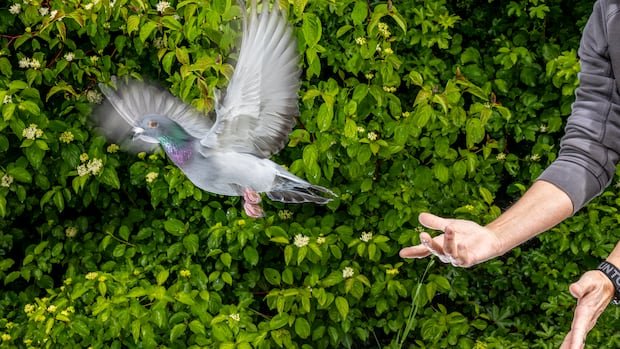

Scientists have made a fascinating discovery regarding how pigeons navigate: they use their livers as a tool for finding their way back home. This surprising revelation sheds light on the remarkable abilities of these birds.
In a notable historical event during the First World War, a courageous homing pigeon named Cher Ami played a crucial role in saving trapped soldiers by delivering a vital message amidst heavy shelling. Throughout history, pigeons have been relied upon for delivering important messages, from ancient Olympic announcements to breaking news delivery for early news agencies.
Researchers have long understood that homing pigeons use various cues like the sun, scents, and visual landmarks for navigation. However, the mystery has persisted regarding how exactly these birds tap into the Earth’s magnetic field for guidance.
A recent study led by Clivia Lisowski from the University of Bonn suggests that iron-rich immune cells in the liver may serve as sensors for detecting the Earth’s magnetic field, aiding pigeons in their navigation. This breakthrough theory emerged from earlier research in mice, which revealed the unique sensitivity of immune cells to magnetic fields due to iron accumulation.
The research team found that macrophages in the liver, responsible for recycling and processing old red blood cells, contain high levels of iron. These cells are positioned near nerve fibers, suggesting a possible pathway for transmitting magnetic information to the pigeon’s brain.
A key experiment involved temporarily depleting macrophages in pigeons using a drug, which resulted in confused and disoriented behavior in the birds under overcast conditions. The untreated pigeons were able to orient themselves, highlighting the crucial role of these liver cells in navigation.
Experts, like David Bird from McGill University, commend this groundbreaking research and anticipate its implications for understanding navigation in other migratory animals. Scott MacDougall-Shackleton from Western University acknowledges the novelty of the findings and suggests that further research is needed to validate the mechanism and explore its broader implications.
Overall, this study offers a fresh perspective on the immune system’s capabilities, showcasing how it may function as a sensory organ. The research not only enhances our understanding of pigeon navigation but also opens up new avenues for studying the complexities of biological systems.