

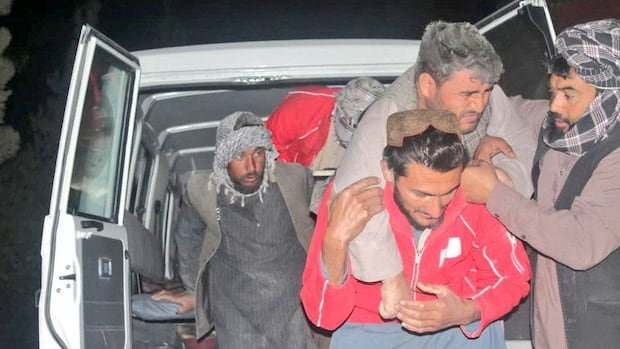

A powerful 6.3-magnitude earthquake struck the vicinity of Mazar-e Sharif in northern Afghanistan in the early hours of Monday, resulting in a tragic loss of at least 20 lives, injuring numerous individuals, and causing significant damage to the city’s renowned Blue Mosque. The U.S. Geological Survey reported that the earthquake originated 28 kilometers deep near Mazar-e Sharif, a city with a population of approximately 523,000 residents.
Describing the terrifying experience, a survivor named Mohammad Rahim from the Tashqurghan district, near the quake’s center, mentioned the intense shaking lasting about 15 seconds. He recounted the chaotic scene of dust filling the air, obstructing visibility, as he stood in front of a collapsed building where his mother and brother were trapped but later rescued by volunteers and rescue teams.
Preliminary figures from the Afghanistan National Disaster Management Authority indicated that the catastrophe claimed the lives of 20 individuals and left 643 injured, with 25 in critical condition. The Health Ministry’s spokesperson, Sharfat Zaman, confirmed the dispatch of rescue and medical teams to the affected region, with nearby hospitals prepared to provide necessary medical care.
The consequences of the earthquake also impacted the historic Blue Mosque, a revered site in Mazar-e Sharif, according to Haji Zaid, spokesperson for Balkh province. The mosque, a sacred place in Afghanistan believed to be the final resting place of the Prophet Mohammad’s cousin and son-in-law, suffered structural damage from the seismic activity.
As relief efforts unfolded, the United Nations mission in Afghanistan expressed its commitment to supporting rescue operations, while India extended its assistance to the affected communities, delivering relief supplies for those impacted by the earthquake.
The recent earthquake further exacerbates the challenges faced by Afghanistan’s Taliban administration, already dealing with crises such as a previous devastating quake in August, diminishing foreign aid, and the mass expulsion of Afghan refugees by neighboring nations. The natural disaster disrupted power supply nationwide, including in the capital city of Kabul, as reported by the national power supplier Da Afghanistan Breshna Company.
Given Afghanistan’s susceptibility to earthquakes due to its location on active fault lines, the country remains at risk for future seismic events. This latest quake compounds the ongoing humanitarian strain in the nation, particularly as winter approaches, posing additional hardships for vulnerable populations, including children and families in earthquake-affected regions.