

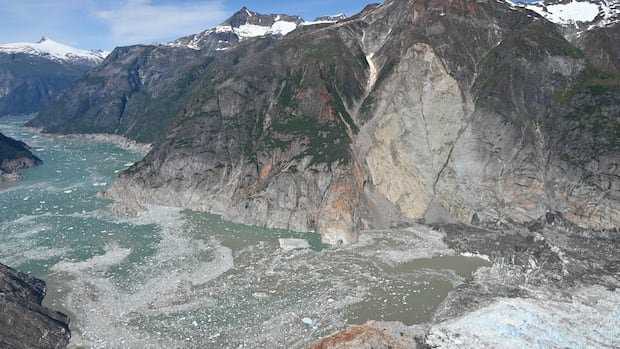

When a massive amount of rock plunged one kilometer into an Alaskan fjord last year, it triggered one of the largest tsunamis ever documented, a colossal 481-meter wave taller than the highest observation deck of the CN Tower, a recent study reveals.
The study, led by Dan Shugar, an associate professor at the University of Calgary, emphasizes the significant impact of the Tracy Arm Fjord tsunami and underscores the urgent need for policymakers, particularly in British Columbia, to prioritize the risks associated with such waves.
The research, published in the journal Science, highlights that the tsunami in the southeast region of Alaska near the northwest B.C. border was likely a result of the rapid retreat of a glacier that would have intersected with the landslide’s path. It warns that with ongoing global warming and the expanding infrastructure and cruise ship tourism, the dangers posed by landslide-induced fjord tsunamis are escalating.
According to the study, the landslide occurred at 5:26 a.m. on Aug. 10 last year, with over 64 million cubic meters of rock plummeting into the narrow and deep Tracy Arm Fjord, creating a wave with the second-highest run-up ever recorded at approximately 481 meters.
Despite the usual presence of about three cruise ships daily in the fjord, during the summer months, Tracy Arm and nearby Endicott Arm fiords see over 20 ships per day. Fortunately, the lone cruise ship present at the time of the tsunami was not in its path, averting a potential catastrophe for the passengers onboard.
The study also reveals that the South Sawyer Glacier near the landslide had significantly receded by about 500 meters in the months leading up to the event. Had the glacier not retreated, the landslide might have either collapsed onto the glacier ice or not occurred at all.
The researchers stress the anthropogenic influence on the warming near the fjord, attributing it to human activities that have led to glacier thinning and retreat. They liken the landslide to a scenario where removing the glacier acted as a latch holding back the rock wall, causing the catastrophic event.
While Shugar does not advocate for a ban on cruise ships and tankers off the Canadian coast due to potential tsunamis, he urges a thorough assessment of the slopes to gauge the risks they pose. Fathian underscores the importance of monitoring seismic activities for early warning systems to prevent future disasters.
In essence, the study urges policymakers to consider the hazard potential of fiords on a national scale and invest in advanced monitoring technologies for timely disaster prevention.