

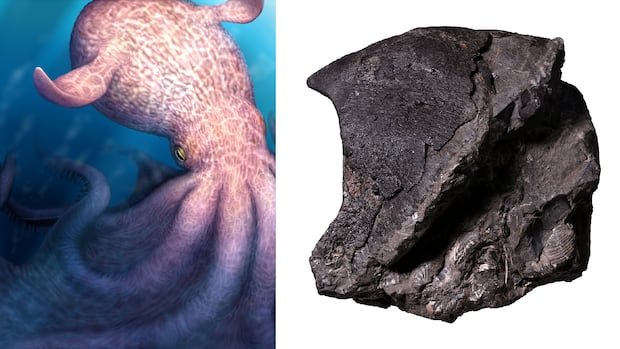

Monstrous octopuses, comparable in size to modern whales, roamed the oceans alongside dinosaurs, using their massive tentacles to capture and devour prey, as indicated by fossils discovered in British Columbia and Japan. A recent study, published in the journal Science, reveals that these sea creatures, resembling mythical tentacled monsters like the Kraken, reached lengths of up to 19 meters, similar to a sei whale’s size, the third largest whale species.
Among the two species identified, Nanaimotethis haggarti, described in the study by Yasuhiro Iba, a professor at the University of Hokkaido, may have been one of the largest invertebrates in Earth’s history. In comparison, the largest known modern invertebrate, the giant or colossal squid, grows to approximately 12 meters in length.
According to Cameron Tsujita, a paleontology expert at Western University in London, Ontario, Nanaimotethis was notably massive, even considering potential measurement errors. The study’s findings suggest that these octopuses possessed the ability to consume well-protected prey with hard shells, evident from the wear patterns on their fossilized beaks.
During a period dominated by large predatory marine reptiles, the presence of giant octopuses like Nanaimotethis would have added a new level of concern for smaller marine creatures such as fish, sea turtles, and ammonites. This discovery underscores the significance of giant invertebrates, specifically octopuses, within the top predator ecosystem.
One intriguing observation highlighted in the study is the asymmetrical wear on the octopuses’ jaws, indicating a preference for seizing prey on one side, a characteristic associated with intelligence. This finding aligns with the reputation of modern octopuses as highly intelligent creatures.
The fossils, primarily beaks or jaws, were unearthed in rock formations in British Columbia and Hokkaido, Japan, with some specimens housed at the Courtenay and District Museum and Paleontological Centre in Courtenay, B.C. These fossils, rare due to the limited fossilization of soft-bodied octopuses, provide valuable insights into prehistoric marine life.
To obtain detailed specimens, researchers utilized a technique termed “digital fossil mining” or “grinding tomography,” involving the gradual layer-by-layer extraction of fossils from rocks. By comparing these detailed specimens to modern squids and octopuses, the researchers confirmed that the Nanaimotethis species were finned octopuses rather than vampire squids, shedding light on their lifestyle in the deep ocean.
The study estimates that these ancient octopuses lived between 100 million to 72 million years ago, making them the oldest known octopus fossils, predating other known octopus fossils by at least five million years. This discovery prompts inquiries into the evolution of octopuses and raises questions about the divergence of modern octopus species from their ancient counterparts.
In summary, the identification of giant prehistoric octopuses offers insights into the ancient marine ecosystem and poses intriguing questions about the evolutionary history of these enigmatic creatures.