

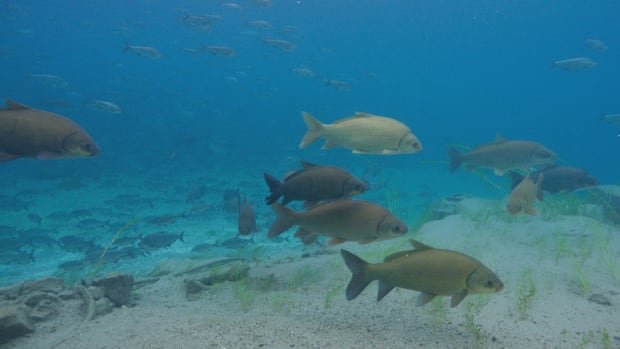

A recent documentary showcased stunning underwater scenes in Lake Huron, labeling a specific area “fish city” due to an apparent abundance of fish. However, the Saugeen Ojibway Nation has contested this portrayal, referring to the location near the warm-water outflow of the Bruce Nuclear Generating Station as a “fish trap” instead.
The First Nation highlighted the deaths of approximately five million gizzard shad in 2025, as documented by the Department of Fisheries and Oceans in a regulatory report from the Canadian Nuclear Safety Commission. This mass mortality event was triggered when a significant number of fish entered the station, leading to the blockage of cooling water intake systems and necessitating the shutdown of a reactor by the utility.
In addition, the Saugeen Ojibway Nation expressed concerns about several lake sturgeon, an at-risk species with cultural significance in Anishnaabe beliefs, becoming stranded at the plant. While one sturgeon was rescued in November with joint efforts from Bruce Power and the First Nation, three others remain in the forebay pond.
The debate surrounding “fish city” extends beyond imagery, raising inquiries about how Bruce Power manages ecological risks as it seeks regulatory approval to enhance plant capacities for increased electricity production. Despite the visible congregation of fish near the station’s warm water discharge, regulatory authorities did not attribute the 2025 die-off to the plant.
Ryan Lauzon, a biologist affiliated with the Saugeen Ojibway Nation and the University of Toronto, conducted a detailed study on the fish kill in 2025, funded by the First Nation. He described the site’s operation in two phases: attraction and entrapment, emphasizing the risks posed to fish drawn into the plant’s systems.
Bruce Power refuted allegations linking the plant to the 2025 mass fish deaths, attributing the event to unusual environmental conditions such as high shad populations and severe winter weather. The utility implemented various deterrent measures and enhanced monitoring following the incident to prevent fish ingress into its systems.
In a bid to meet rising energy demands, Bruce Power sought approval from regulators to boost electricity generation from existing reactors by approximately 11% by 2030. This request is under review, with a final hearing scheduled for July 2026, emphasizing the importance of safety and environmental considerations in any operational changes.
While operating within strict regulatory frameworks, Bruce Power acknowledged the absence of clear benchmarks to assess the acceptability of fish losses associated with plant operations. This ambiguity underscores the need for comprehensive population knowledge to determine environmental risks and thresholds.
The significance of gizzard shad in the lake ecosystem was highlighted by Paul Jones, a former fisherman and councilor with the Chippewas of the Nawash Unceded First Nation, emphasizing the ecological and cultural importance of fish in the region. The removal of shad from the ecosystem through mass die-offs can have far-reaching impacts on other species and the local community’s way of life.