

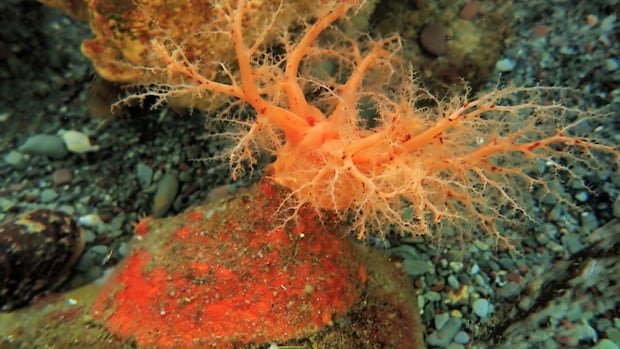

A recent study led by Sara Jobson, a doctoral student at Memorial University in Newfoundland and Labrador, has revealed a remarkable phenomenon in scarlet sea cucumbers. The research discovered that amputated tissue from these sea creatures can persist for years in a unique state between life and death.
Jobson and her team observed the severed tissue of scarlet sea cucumbers, known as “little lab zombies,” exhibiting unprecedented survival capabilities. Unlike typical animal flesh, which would perish when detached, the scarlet sea cucumber tissue demonstrated resilience by sterilizing the amputation site and sealing the wound off from the environment.
Over a span of several years, the tissue fragments transformed into round, translucent structures with a central red pigment nucleus. Despite not regenerating into new sea cucumbers, these tissue samples evolved into distinct biological units that sustained themselves by absorbing nutrients and maintaining an active immune system, resembling living organisms without the ability to reproduce.
Described as “zombie tissue” by Jobson, this peculiar phenomenon blurs the line between life and death, raising questions about its evolutionary advantage for scarlet sea cucumbers. The study, published in Science Advances, highlighted the potential for further scientific exploration enabled by the survival of these resilient tissue samples.
Jobson emphasized the importance of supporting curiosity-driven research that allows for unconventional inquiries, leading to groundbreaking discoveries like the immortalized scarlet sea cucumber tissue. The study’s findings offer a gateway to new scientific opportunities, including investigating the aging process of these enigmatic tissue samples.
The research, conducted under the guidance of Annie Mercier, a professor of ocean sciences at Memorial University, underscores the significance of fostering innovative scientific exploration to uncover extraordinary phenomena in the natural world.