

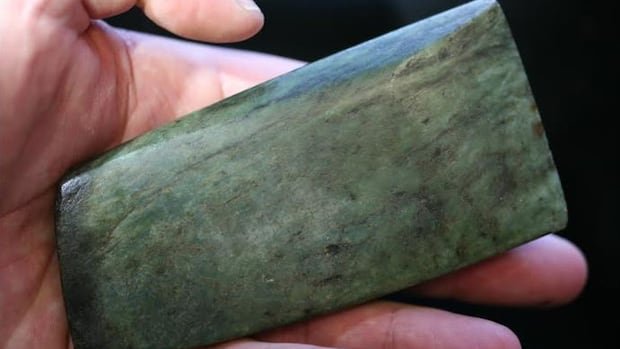

A recent study on jade artifacts discovered east of the Rocky Mountains has revealed insights into extensive Indigenous trade networks in pre-colonial Western Canada.
Over a span of more than 3,000 years, skilled artisans crafted nephrite jade into blades, chisels, and axe heads. These tools, made from a durable stone available in various colors like emerald green, black, yellow, and white, were crucial for central and coastal Salish communities in the Pacific Northwest, aiding in woodcarving activities essential for daily living.
While the origins of these stone tools can be traced back to quarries in British Columbia, some have been found as far as Alberta, Saskatchewan, and Manitoba, indicating extensive trade routes. A recent peer-reviewed study conducted by the Edmonton-based Archaeological Survey of Alberta, in collaboration with researchers from the University of Alberta, University of British Columbia, University of Saskatchewan, and Royal Saskatchewan Museum, delved into the significance of these tools known as stone celts, suggesting their role as prized possessions in the Prairies.
According to Todd Kristensen, regional archaeologist at the Archaeological Survey of Alberta and lead author of the study, the distribution of these artifacts highlights the development of large social networks among Indigenous communities across Western Canada. The jade items, primarily crafted in British Columbia, were passed on to Dene and Cree groups beyond the Rockies through extensive trade networks, symbolizing social ties and alliances rather than mere functional tools.
Unraveling the Enigma
The study aimed to address long-standing questions in anthropology regarding the presence of nephrite artifacts east of the Rockies, a phenomenon that had received little attention in the past. With no local sources of nephrite or evidence of crafting in the Prairies, researchers sought to understand the origins and transportation mechanisms of these artifacts.
Through rigorous analysis using portable X-ray fluorescence, gamma spectrometry, and specific gravity testing, the study confirmed that all 24 recorded nephrite celts originated from the Fraser River region of British Columbia and traveled an average distance of nearly 850 kilometers, with some covering up to 1,500 kilometers.
The research proposed several possible trade routes, indicating interactions between Interior Salish artisans and neighboring Dene groups, as well as the exchange between Salish and Dene communities across the Rockies. Kristensen highlighted the labor-intensive process involved in crafting a nephrite celt, with some pieces requiring over 100 hours of work, underscoring their value as prestigious items rather than mere tools.
The study’s findings shed light on the interconnectedness of Indigenous communities in Western Canada, challenging the notion of isolated hunter-gatherer societies and emphasizing the importance of relationships in pre-contact cultures.
Kisha Supernant, director of the Institute of Prairie and Indigenous Archaeology at the University of Alberta, commended the researchers for engaging with Indigenous communities and integrating traditional oral histories into their research, enriching the understanding of pre-contact Indigenous cultures and emphasizing the human aspect of archaeology.
Looking ahead, the research team plans to further collaborate with Indigenous communities to merge their findings with oral traditions, enriching the narrative of Indigenous connections and long-distance trade in the region.