

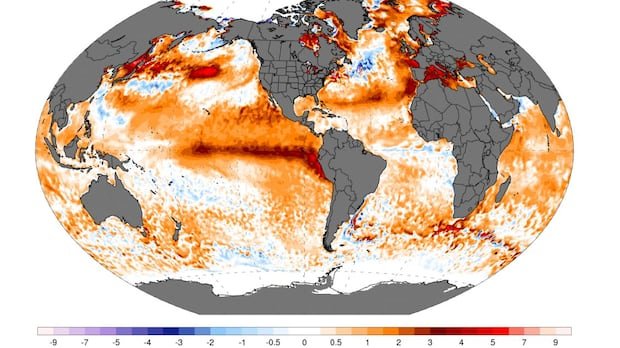

The much-anticipated El Niño phenomenon has arrived and is already proving to be significant. Earlier in the year, climate experts had predicted the development of an El Niño in the central Pacific region. Over time, more models started suggesting a potentially strong or “super” El Niño, although it was cautioned that certainty was still premature.
In their monthly update in June, the U.S. National Oceanic and Atmospheric Administration (NOAA) officially declared the presence of warmer conditions in the specific Niño 3.4 region of the Pacific Ocean, confirming the El Niño advisory. For an official El Niño classification, temperatures in this zone must be at least 0.5°C above average. Currently, ocean temperatures are nearly 2°C above the norm, setting a record high for this time of year.
Zeke Hausfather, a climate scientist at Berkeley Earth, noted that temperatures in the traditional Nino 3.4 region are slightly surpassing 2°C, indicating a strong El Niño status. The situation is remarkable as it’s only early July. El Niño and La Niña are part of the broader El Niño Southern Oscillation (ENSO) cycle, impacting the Pacific Ocean with varying temperature changes.
Predictions anticipate the peak of this El Niño event to be around October, with some models suggesting a later peak in November or December. Comparisons have been made to the powerful 2015-2016 El Niño, where temperatures spiked by approximately 2.75°C. The rapid transition from La Niña to El Niño has caught experts’ attention, with some attributing the swift change to unknown factors.
The possibility of a 4°C temperature anomaly from models initially seemed far-fetched, but current projections are leaning towards this extreme scenario. The role of climate change in influencing these fluctuations remains a topic of debate among scientists, with uncertainties prevailing. Concerns over potential impacts on food security in tropical regions due to expected droughts and the implications for Canada, including milder winters and dry conditions fostering wildfires, are looming large.
In summary, the El Niño event is shaping up to have significant repercussions across various sectors, warranting preparedness for the potential outcomes.