

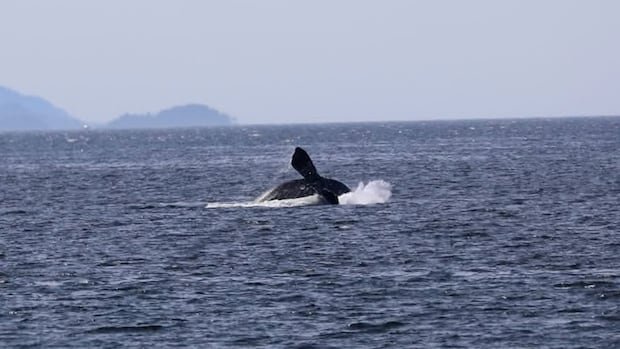

Troy Bright, a veteran whale observer at his research base near Malcolm Island, recently had a remarkable encounter with a previously unseen whale. The whale breached multiple times right in front of him, a behavior he had never witnessed before. Bright, who has been studying whales for three decades with Bere Point Research, immediately grabbed his camera to capture images of this unusual whale.
The distinct characteristics of this whale, particularly its short and dark pectoral fins, set it apart from humpback whales, as noted by Bright and other cetacean experts. The experts confirmed that the whale in question was a North Pacific right whale, a critically endangered species known to be the rarest whale on the planet.
Jared Towers, a cetacean research technician from the Department of Fisheries and Oceans (DFO) residing in Alert Bay, spent hours searching for the elusive whale. Towers emphasized that the discovery was only possible because the whale was rolling near the surface with a piece of kelp, making it easily missed in the vast waters.
The juvenile North Pacific right whale spotted off Malcolm Island is a significant find, as these whales have been sighted only seven times in British Columbia. Towers described this whale as a juvenile, estimating that it may be the first documented sighting of its kind. The sighting is a positive development for the small population of fewer than 50 North Pacific right whales, hinting at the presence of a calf, a rare occurrence after many years of absence.
Researchers remain curious about the birthing grounds of these whales, as there is limited knowledge about North Pacific right whales in Canada due to the scarcity of sightings. In 2024, DFO collaborated with NOAA scientists to detect the acoustics of these whales off Langara Island near Haida Gwaii using sonobuoys.
The recent sighting of a North Pacific right whale in Canadian waters has attracted attention from researchers in the United States. Kevin Campion, the founder of Save the North Pacific Right Whales based in Washington state and Oregon, expressed excitement over the discovery, emphasizing the critical status of these whales due to past hunting activities.
The species faced extensive hunting during the 19th and early 20th centuries, leading to their endangered status today. Campion highlighted the threats faced by North Pacific right whales, including prey scarcity, entanglements, and ship strikes, underscoring the responsibility to aid in their recovery.
These large whales feed by skimming the water with their mouths open, consuming copepods, tiny crustaceans, showcasing the intricate balance of marine ecosystems. The recent sighting offers hope for researchers to gain valuable insights into these elusive creatures, emphasizing the importance of learning more about their behaviors and habitats for effective conservation efforts.