

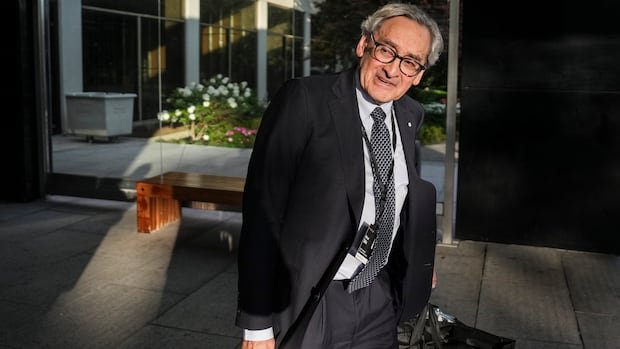

Privy Council Clerk Michael Sabia, responsible for overseeing Prime Minister Mark Carney’s adherence to ethics guidelines to avoid any personal gain from his decisions in office, emphasized the proactive nature of the prime minister’s ethics screen. Sabia testified in Ottawa before Conservative MPs on the House ethics committee who are scrutinizing whether Carney has benefited financially from his policy choices.
The ethics screen was activated earlier this year following Carney’s full disclosure of his assets to the federal ethics commissioner, who enforces the Conflict of Interest Act for public office holders. Carney moved the majority of his assets, except for select cash, his residence, and vacation property, into a blind trust after winning the Liberal leadership.
In a blind trust arrangement, the trustee has full ownership of the assets and can manage them independently without input from Carney, who remains unaware of the trust’s assets. The purpose of the ethics screen is to prevent Carney from engaging in decisions that could favor the assets as they existed before being placed in the blind trust.
Carney’s ethics screen encompasses over 100 companies where he had interests, prohibiting him from participating in any decision-making processes that could advance those companies’ interests during his tenure as prime minister.
Sabia disclosed that the ethics screen has been invoked 13 times thus far, with six instances where Carney was restricted from making decisions. Each activation was reviewed with the ethics commissioner to ensure compliance. The screen was deactivated in seven cases where decisions did not involve the disclosed companies or related to general tax measures.
The Conflict of Interest Act sets out regulations and timeframes to prevent officials from making decisions that could benefit them or their families. Carney, a former board chair of Brookfield Asset Management and a seasoned financial figure, is subject to restrictions on owning “controlled assets” that could be influenced by government actions. These assets must either be divested in an arm’s-length transaction or placed in a blind trust.
Opposition MPs have questioned the adequacy of existing laws, with some suggesting complete divestment of assets as a more stringent approach to avoid any perception of conflicts of interest. Sabia defended the current system’s robustness while indicating that it’s within the purview of parliamentarians to update regulations. He cautioned against overly stringent measures that could deter talented individuals from transitioning from the private sector to public service.
The ethics screen, overseen by Sabia and Carney’s chief of staff Marc-André Blanchard, specifically mentions official matters involving Brookfield and Stripe, a company on whose board Carney served. Public filings show Carney had investments in both companies at the time of divestment. While the exact value of these holdings was undisclosed, Brookfield’s financial report revealed Carney held approximately $6.8 million US in unexercised stock options as of Dec. 31, with fluctuating values since then.