

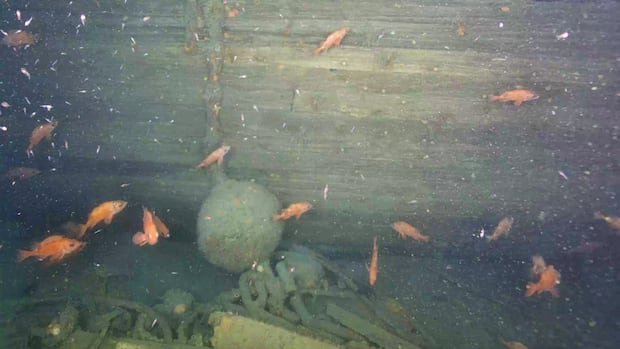

An underwater expedition nearly 400 meters deep in the Labrador Sea has unveiled the initial images of Quest, the vessel that carried renowned Antarctic explorer Sir Ernest Shackleton on his last journey. The Royal Canadian Geographical Society (RCGS) deployed a remotely operated vehicle (ROV) to capture visuals of the ship’s location where it sank off the Labrador coast in 1962.
CBC News participated in the research aboard the vessel Atlantis, gaining exclusive access to the expedition’s first images showing the stern of the exploration vessel entangled in fishing equipment. David Mearns, co-chief scientist for the expedition and an experienced shipwreck locator with 29 discoveries, expressed concern about the wreck’s condition due to the entangled nets potentially causing more damage than if it had remained undisturbed on the seabed. The RCGS initially identified the Quest wreck two years ago using side-scan sonar technology.
The images revealed that a significant portion of Quest is ensnared in aged fishing gear, with the wreck situated in Hawke Channel, an area closed to fishing since 2002, as reported by Canadian Geographic. Despite the absence of indications of nets in the original data, Mearns expressed disappointment at the discovery during the current expedition.
The RCGS collaborated with the Woods Hole Oceanographic Institution from Massachusetts, utilizing their vessel and submersible to explore two shipwrecks in the Labrador Sea. John Geiger, CEO of the RCGS and leader of the expedition, participated in the initial dive to the wreck aboard the submersible Alvin, where he described the emotional experience of encountering the ship’s bow emerging from the darkness.
Quest was originally acquired by Shackleton for Northern Canada exploration, but diverted to Antarctic expeditions when Canadian government support was lacking. The ship served various purposes post-Shackleton era, including wartime mine sweeping and seal hunting before sinking in 1962 off Labrador’s south coast due to ice pressure. The crew survived, though the cargo of numerous seal pelts was lost.
The wreck’s identity as Quest was confirmed by research director Antoine Normandin, citing distinct features like matching portholes below the bridge with historical photographs. The expedition aims to create a digital replica of the wreck through 3D imaging technology, despite challenges in capturing clear imagery due to fishing nets obstructing the starboard side.
Following investigations on Quest, the expedition will proceed to explore another wreck, Terra Nova, at Greenland’s southern tip. Terra Nova, originally owned by the Bowring Company, was utilized by Robert Falcon Scott in his fatal 1912 South Pole expedition. The RCGS’s mission seeks to unravel the mysteries surrounding the wrecks, their alterations over time, and the insights the wrecks and the surrounding debris fields can provide.
The voyage represents the RCGS’s largest expedition to date, with substantial financial investment.