

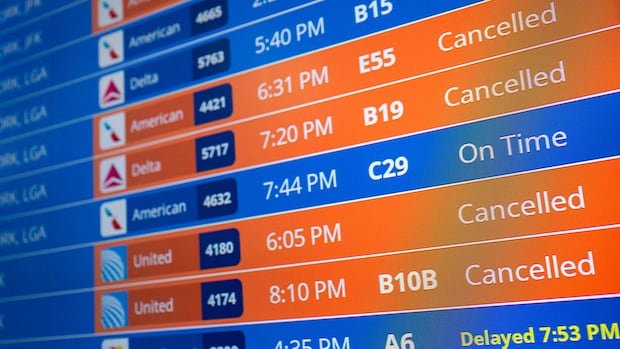

The challenges encountered by Americans at airports nationwide are projected to escalate this week if Congress fails to strike a deal to end the ongoing government shutdown. U.S. airlines scrapped over 1,500 flights on Saturday and more than 2,900 on Sunday to adhere to a Federal Aviation Administration (FAA) directive aimed at easing air traffic flow, as some unpaid air traffic controllers have been absent from work for nearly a month.
By early Monday, airlines had already canceled close to 1,600 flights for Monday and nearly 1,000 for Tuesday, marking the fourth consecutive day with cancellations surpassing 1,000. The situation was further complicated by a winter storm in Chicago during November.
Although the Senate initiated steps to end the shutdown on Sunday, final approval could still be days away. Experts anticipate that even after the government reopens, it will take time for flight operations to normalize.
Numerous airports are experiencing significant delays for flights that have not been canceled, with Newark, Orlando, Chicago, and Detroit airports reporting departure delays exceeding an hour. This marks the second pay period where air traffic controllers have not received compensation for their services. The head of the air traffic controllers union, Nick Daniels, is scheduled to hold a news briefing on Monday morning to discuss the shutdown’s impact on their workforce.
The situation is poised to deteriorate as airlines struggle to reposition aircraft, pilots, and flight attendants due to the shortage of air traffic controllers. The FAA has enforced a four percent mandatory flight reduction over the weekend to manage staffing, with plans to increase to six percent on Tuesday and ten percent by the upcoming weekend. U.S. Transportation Secretary Sean Duffy mentioned on Fox News Sunday that additional flight cuts of up to 20 percent might be necessary.
The ongoing shortage of air traffic controllers has been a longstanding issue for the U.S. government, with the shutdown exacerbating the problem and prompting some controllers to expedite their retirements. While a four percent reduction may seem modest, a significant portion of this reduction affects operations at 40 of the busiest and most congested airports in the country. The FAA emphasized that flight reductions are essential to ensure traveler safety, given the extended hours and mandatory overtime that the remaining controllers have been working amidst the government funding stalemate.
If left unresolved, the situation could deteriorate further as the U.S. approaches the peak holiday travel season, potentially resulting in a significant reduction in air travel around American Thanksgiving week.