

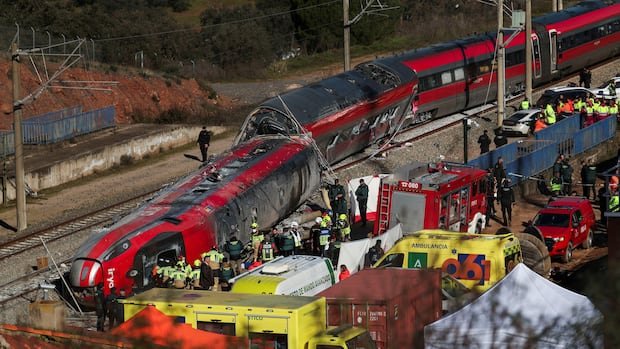

Experts investigating the cause of the high-speed train derailment in Spain on Sunday, which resulted in the tragic deaths of at least 40 individuals, have discovered a broken joint on the railway tracks, as per details shared by a source familiar with the preliminary inquiries into the incident. The carriages that derailed collided with an oncoming train, causing it to veer off the tracks and down an embankment, marking one of Europe’s most severe train disasters in recent history.
The catastrophic event unfolded near Adamuz in the province of Cordoba, approximately 360 kilometers south of Madrid, the capital. Following the accident, twelve individuals were admitted to intensive care, as confirmed by emergency services. On-site technicians examining the rails observed signs of wear on the joint connecting the rail sections, known as a fishplate, indicating a pre-existing fault that had developed over time.
The analysis revealed that the defective joint had created a gap between the rail segments, which widened with continued train traffic on the route. The technicians believe that pinpointing the faulty joint is crucial in determining the exact cause of the tragedy. The Commission of Investigation of Rail Accidents (CIAF) in Spain, responsible for overseeing the comprehensive investigation into the incident, has not yet issued a formal statement in response to inquiries.
Álvaro Fernandez Heredia, the president of Renfe, the operator of the second derailed train, refrained from speculating on the cause but described the circumstances surrounding the accident as unusual. He stated that the likelihood of human error playing a role in the incident was minimal. A Spanish train drivers’ union had previously cautioned the rail operator ADIF about significant wear and tear on high-speed tracks, including the location of the collision, in a letter dated August, citing ongoing concerns that were reportedly disregarded.
The first carriages of the train managed by Iryo crossed over the rail gap without incident, but the eighth carriage, along with the seventh and sixth, derailed, as per the source. Iryo, a privately-owned rail operator, with the majority stake held by the Italian state-controlled railway group Ferrovie dello Stato, was in charge of the train operation. The presence of the gap in the vertical rail was highlighted in a photograph distributed by Spain’s Guardia Civil, with the area marked for inspection by forensic experts.
Spanish Prime Minister Pedro Sanchez and Transport Minister Oscar Puente visited the crash site on Monday, with Sanchez canceling his scheduled participation at the World Economic Forum in Davos, Switzerland, following the tragedy. Puente mentioned that the Iryo train was relatively new, less than four years old, and that the railway track had undergone a complete renovation in May. Hitachi Rail, the train manufacturer, conducted a routine inspection on Jan. 15, finding no irregularities in the train’s condition, according to the source.
The train involved in the derailment is a Frecciarossa 1000, the same model utilized on Italy’s high-speed rail network. Global Affairs Canada confirmed that there were no reports of Canadian citizens affected by the derailment.