

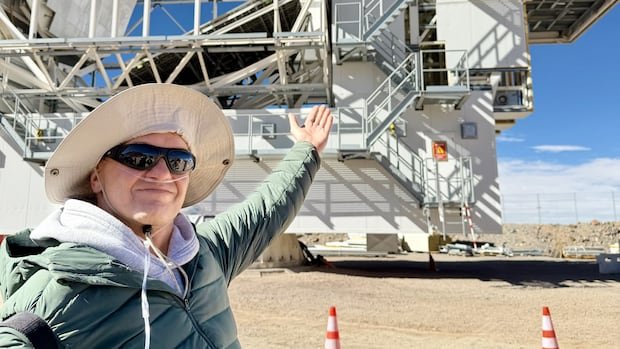

Researchers from various Canadian institutions are playing a crucial role in a groundbreaking new telescope situated at an exceptionally high altitude, poised to unravel profound mysteries of the universe. Positioned at an elevation of approximately 5,600 meters in Chile’s Atacama Desert, higher than the Mount Everest base camp, the Fred Young Submillimeter Telescope is designed to avoid atmospheric disruptions such as water vapor, ensuring unparalleled visibility.
According to Scott Chapman, an astrophysics professor at Dalhousie University, the telescope’s location offers a unique opportunity to unveil new cosmic insights. Mike Fich, leading the Canadian team and an astronomer at the University of Waterloo, highlighted the exceptional clarity of the telescope’s observations, previously thought achievable only from space, albeit at significantly higher costs.
The telescope project, spearheaded by Cornell University’s CCAT Observatory in New York in collaboration with Chilean, German, and Canadian universities, aims to explore the formation and dynamics of stars and galaxies, as well as shed light on dark energy, dark matter, and the universe’s early evolution. The telescope’s wide field of view enables swift scanning across vast areas of the sky, facilitating comprehensive mapping.
Chapman, alongside researchers from Dalhousie, the University of British Columbia, and the National Research Council, has developed cutting-edge quantum sensor cameras capable of detecting submillimeter wavelengths of light, a critical capability for observing cold gas clouds where stars originate. The telescope’s ability to peer into the distant past by capturing light emitted eons ago from galaxies will provide invaluable insights into cosmic evolution.
With an estimated cost of $40 million, the telescope required meticulous planning and construction at extreme altitudes, demanding specialized infrastructure like oxygen supplies and dedicated power stations. The project’s data processing needs are substantial, with German partners establishing a high-capacity computing center to handle the terabytes of data generated daily.
Chapman’s cameras are set for installation on the telescope in the upcoming summer, with initial data anticipated by mid-fall. The comprehensive analysis of the vast data collected is expected to yield groundbreaking discoveries, which will be shared with the scientific community approximately a year after the findings are obtained.