

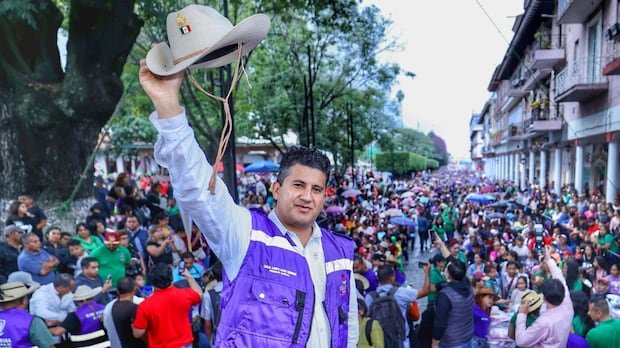

Shortly after 8 p.m. last Saturday, a young hitman, disguised in a white hoodie, left Hotel Alamada and headed towards Plaza Morelos in Uruapan, a city in western Mexico known as the avocado capital of the world. His target was Mayor Carlos Manzo, who had gained national attention for his outspoken stance against organized crime groups in the region.
The assassin, armed with a 9-mm Beretta handgun, navigated through the crowded plaza, where families were gathered for the Festival of Candles as part of the local Day of the Dead festivities. Surveillance footage released by local authorities depicted the assassin approaching Manzo, who was also dressed in white and accompanied by his family while interacting with the crowd.
In a swift move, the assassin fired seven shots at Manzo before the mayor’s bodyguards, provided by the federal government, reacted belatedly with lethal force. The tragic incident sparked outrage and protests across Michoacan, a state known for its lime and avocado production, affecting the city of Uruapan, the state’s second-largest with a population of 400,000.
The assassin was identified as 17-year-old Víctor Manuel Ubaldo Vidales from Paracho, Michoacan. Investigations revealed that Ubaldo Vidales, who was addicted to methamphetamines, was under the influence of drugs during the attack. Ballistics tests confirmed that the weapon used had been previously involved in three other fatal incidents.
Mayor Manzo’s assassination has triggered widespread anger in Michoacan, where residents are tired of the prevailing violence and corruption. The incident has also led to demonstrations in Mexico City, 400 kilometers away from Uruapan. The community’s strong reaction to the political killing has been unprecedented, according to Francisco Garcia Davish, the founder of Quadratin Mexico, a news agency with a significant presence in Mexican states.
Additionally, the slain mayor’s widow, Grecia Quiroz, who has taken over as Uruapan’s mayor, urged protesters to demonstrate peacefully in honor of her late husband. Manzo stood out as a courageous and honest leader who defied criminal elements in the region, unlike many other municipal officials who succumb to their influence, as noted by security consultant David Saucedo.
Manzo’s tough stance against crime groups and his efforts to combat them made him a target. His aggressive approach in dealing with the criminal underworld, including the arrest of a prominent cartel leader, earned him both praise and enemies. The circumstances surrounding his assassination suggest it was a calculated move to deter other officials from challenging the criminal syndicates in the region.
As Michoacan grapples with the aftermath of Manzo’s killing, Mexican President Claudia Sheinbaum has vowed to bring peace and justice to the region without resorting to the failed “narco wars” of the past. The history of the region’s cartel conflicts underscores the challenges facing authorities in maintaining order and security in Michoacan amid the ongoing power struggles among criminal factions.