

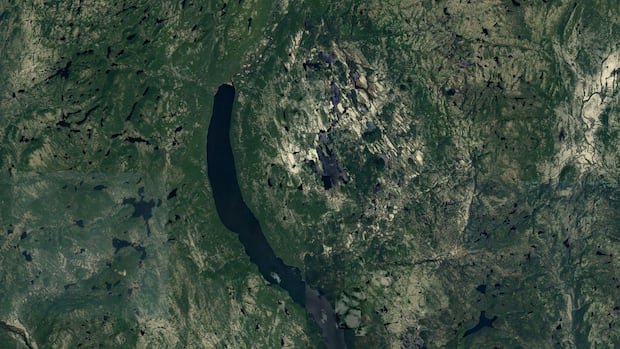

Amateur stargazer Joël Lapointe made a serendipitous find in Quebec’s Côte-Nord region in 2024 while casually exploring with Google Maps. Initially planning a camping trip, he unexpectedly stumbled upon what researchers later identified as a previously unknown meteor crater dating back 390 million years.
Gordon Osinski, a planetary geology professor at Western University and part of the team that authenticated the crater on-site in 2025, expressed excitement about the discovery. Despite frequently receiving reports of potential new craters through his Impact Earth platform, Osinski highlighted the rarity of this find, emphasizing the element of surprise in such cases.
Osinski and Jérôme Gattacceca, a geologist from the European Centre for Research and Teaching in Environmental Geosciences, embarked on a challenging expedition to the crater following Lapointe’s headline-grabbing revelation in 2024. The arduous journey involved traversing rugged terrain and wading ashore from a floating plane, making it one of Osinski’s most demanding field missions to date.
During the five-day endeavor, the team collected samples and images for analysis in labs in France and Ontario. Noteworthy discoveries included impact melt rock formations resulting from the intense heat and pressure of the meteor impact. Additionally, the team identified shatter cones, distinctive shockwave remnants found only in impact craters or nuclear test sites, further corroborating the meteorite impact theory.
The expedition allowed for the dating of the crater to be estimated at 390 million years old, a standard geological age according to Gattacceca. He described the discovery as a captivating reminder of the Earth’s enduring capacity to surprise and inspire awe, despite extensive scientific exploration.
Lapointe, in a statement to Radio-Canada, expressed delight at the confirmation of the ancient crater he inadvertently discovered, emphasizing the significance of ordinary citizens contributing to scientific breakthroughs. He commended the selection of the crater’s name, Uhackatik, in consultation with the Innu Council of Ekuanitshit, and encouraged others to trust their instincts and observations, regardless of their expertise.
In an upcoming presentation in Germany, Osinski will share the team’s findings at the annual congress of the Meteoritical Society, highlighting the significance of this remarkable discovery in the realm of planetary sciences.