



Prime Minister Mark Carney has indicated that U.S. President Donald Trump has not suggested any intentions of abandoning the North American free trade agreement established during his initial term in office.
Carney held a private meeting with Trump and Mexican President Claudia Sheinbaum in Washington earlier this month amidst the FIFA World Cup draw.
The discussions primarily focused on the preliminary framework for future talks regarding the Canada-U.S.-Mexico Agreement (CUSMA), which is scheduled for a review in 2026.
“During our conversation, the two presidents and I discussed the process for reviewing and renegotiating CUSMA. We explored possible timelines, although we didn’t finalize any specific dates,” Carney stated in an end-of-year interview with CBC’s Rosemary Barton Live scheduled to air on Sunday.
U.S. Trade Representative Jamieson Greer recently mentioned the possibility of the U.S. pursuing separate agreements with Canada and Mexico, or even potentially withdrawing from the existing deal.
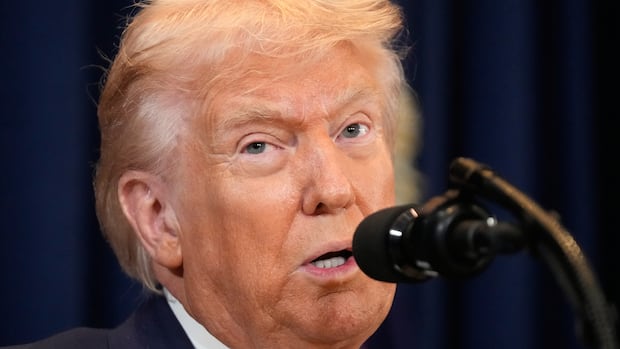
Prime Minister Mark Carney engaged in a year-end interview with CBC News chief political correspondent Rosemary Barton, where he discussed his expectations for the upcoming CUSMA review.
“Could it be exited? Yes, it could. Could it be revised? Certainly. Could it be renegotiated? Yes,” Greer stated. “All these possibilities are on the table.”
In a report submitted to the U.S. Congress on Wednesday, Greer noted that he “will keep the president’s options open, negotiating firmly to address the identified issues, but will only recommend renewal if a resolution can be reached.”
Trump previously threatened to withdraw from CUSMA’s predecessor, NAFTA, during negotiations in his first term and has expressed similar sentiments regarding CUSMA publicly at the White House.
However, Carney asserted that the president “did not express any of those concerns” during their private conversations.
“My discussions with President Trump — as have been President Sheinbaum’s discussions with him — have indicated that there will be a review and adjustments to CUSMA, but not a complete withdrawal from the agreement,” he informed host Rosemary Barton.
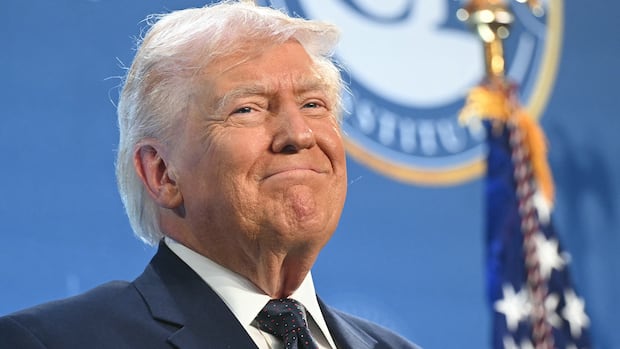
The three North American leaders are seen during the FIFA World Cup draw on Dec. 5. (Adrian Wyld/The Canadian Press)
Despite the existing trade agreement, the U.S. continues to impose 50 percent tariffs on Canadian steel and aluminum, 10 percent on lumber, and 25 percent on certain automotive exports and other goods like kitchen cabinets.
Carney emerged victorious in April’s federal election, positioning himself as the candidate best equipped to manage relations with the U.S. president.
Following the election, the prime minister has undertaken several measures to placate the U.S. administration, including retracting a proposed digital services tax and eliminating many retaliatory tariffs on U.S. products.
Despite these efforts, an agreement to lift at least some of the U.S. sectoral tariffs has yet to be achieved.
Conservative Leader Pierre Poilievre has criticized the prime minister in the House this fall for his inability to finalize a deal on sectoral tariffs.
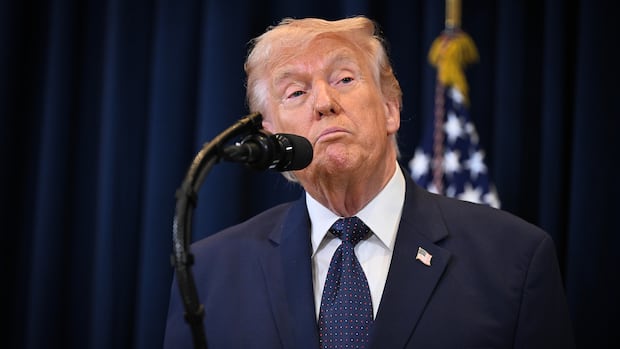
Conservative Leader Pierre Poilievre, during question period on Monday, directed his comments at Prime Minister Mark Carney, stating ‘who cares’ when asked about the timeline for his last conversation with U.S. President Donald Trump. Minister of Canada-U.S. Trade Dominic LeBlanc responded by asserting that the government will keep negotiating with the United States.
“U.S. tariffs on Canadian goods are twice as high as when you were elected promising to eliminate them. You vowed to take a strong stance, but ultimately retreated on dollar-for-dollar counter-tariffs, the digital services tax, and more without securing any concessions for Canada,” Poilievre expressed in a letter to Carney in October.
- This Saturday, Just Asking wants to know: What questions do you have about Canadian politics this year? Fill out this form and send us your questions.
Carney has defended his trade record, claiming that Canada “has the most favorable deal” with the U.S. due to various tariff exemptions under CUSMA that other nations facing American tariffs do not receive.
“The challenge is that the United States has fundamentally altered its trading relationships globally, including with Canada,” he remarked to Barton.
“Having the best deal is commendable, but there’s always room for improvement. It’s clearly in Canada’s best interest for it to be enhanced.”
-
Carney says ‘spectrum of MPs’ attracted to his party, dismisses claim he’s manipulating a majority
-
FRONT BURNER
What did Reagan really believe about tariffs?
Reportedly, discussions with the U.S. to reduce steel and aluminum tariffs were making headway, but Trump cancelled them in October, responding to an anti-tariff advertisement campaign by the Ontario government.
Canada-U.S. Trade Minister Dominic LeBlanc indicated earlier this week that American officials are welcome to resume trade discussions with Canada, but the next opportunity for direct trade engagement is likely to occur during the CUSMA review.

Chief political correspondent Rosemary Barton speaks with Dominic LeBlanc, the minister responsible for Canada-U.S. trade, about the potential restart of trade negotiations in Washington and the likelihood of the U.S. withdrawing from the trilateral agreement. Additionally, former deputy trade minister for Mexico Juan Carlos Baker discusses the dynamic between Canada and Mexico as both nations face pressure from U.S. tariffs. Moreover, Maureen Pinkney, the mayor of 100 Mile House, B.C., talks about the consequences of U.S. tariffs on a lumber mill closure in her community, affecting over 100 jobs.
Carney mentioned that the current sectoral tariffs will “necessarily form a part” of the CUSMA discussions.
“The United States must decide whether it recognizes and values that it is in a stronger position with relatively free movement of automobile, steel, aluminum, lumber, and aerospace across the U.S. border,” the prime minister stated.
“Does it see Canada as a competitor, or does it consider China to be its primary competitor?”
You can catch more of the year-end interview with Prime Minister Mark Carney this Sunday on Rosemary Barton Live starting at 10 a.m. ET.