

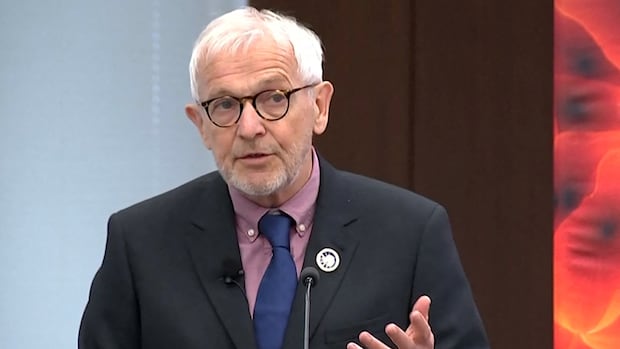

On Tuesday in Stockholm, Belgian American particle physicist Francis Halzen was named the recipient of the 2026 Nobel Prize in Physics.
The 82-year-old Halzen was honored for his “significant contributions to the IceCube Neutrino Observatory and the identification of high-energy neutrinos from astrophysical sources,” according to the awarding organization. This observatory is situated at the Amundsen–Scott South Pole Station in Antarctica.
Halzen discovered that the ice at the South Pole could be utilized to detect neutrinos, often referred to as “ghost particles” due to their ability to traverse the Earth and human bodies without leaving a trace, only interacting with matter on rare occasions.
“These messengers provide insights from the cosmos,” remarked Eva Olsson from the Royal Swedish Academy of Sciences during a news briefing. “They unlock the secrets of distant galaxies and inform us about the phenomena surrounding exploding stars.”
The Royal Swedish Academy of Sciences selects the Nobel prize winners in physics annually, with each recipient receiving a total prize of 12 million Swedish crowns (approximately $1.7 million CAD).
-
Canadian lab tracks neutrinos to study mysteries of universe
-
IceCube detector in Antarctica observes high-energy neutrinos
Launched in 2011, the IceCube observatory spans a full cubic kilometer, representing the realization of a vision for a South Pole observatory that began in the late 1980s, according to the academy.
Halzen expressed gratitude during a telephone news conference, stating, “I must highlight how fortunate I was because, when we initiated this project, everyone acknowledged it might be a good concept, but very few believed it would be successful, including myself.”
Affiliated with the University of Wisconsin–Madison for several decades, Halzen shared that he felt “overjoyed” and “taken aback” by the announcement while attending a conference in Italy.
In 2014, Smithsonian magazine honored Halzen with the title “Neutrino Man” while presenting him one of its Ingenuity Awards.

The Nobel Prize for Physics was awarded today, revealing the scientist’s strong connections to Sudbury. We’ll hear further insights from SNOLAB executive director Jodi Cooley.
Insights into the Universe
Neutrinos are ubiquitous, extremely small cosmic particles with an astonishingly low mass. They are emitted by stars like the sun, and trillions of them pass through our bodies every second.
Scientists cannot directly observe these enigmatic ghost particles. Instead, they analyze the results of collisions between these tiny particles and other matter, which produce flashes of light or charged particles.
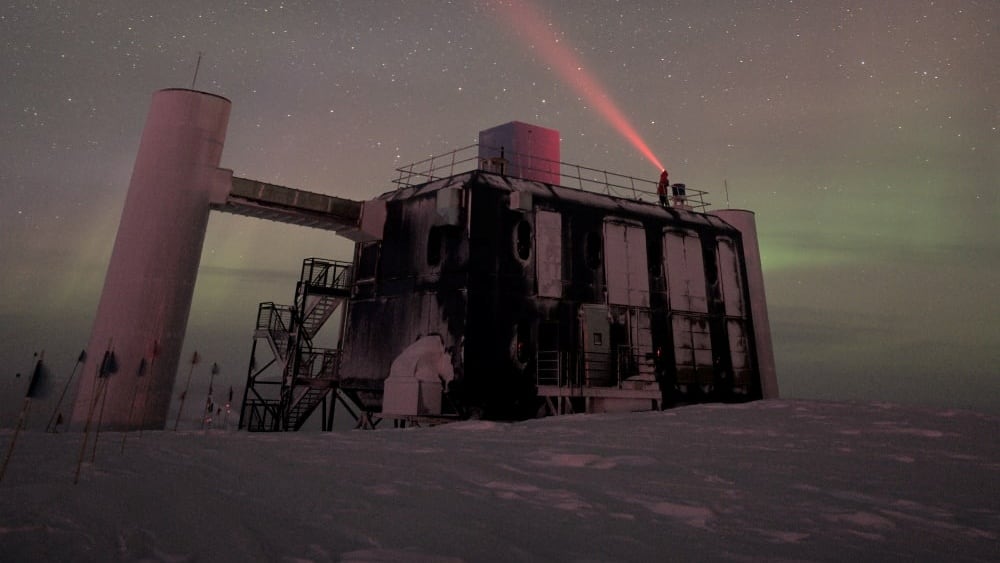
A view of the IceCube Neutrino Observatory at the South Pole is depicted in this undated handout image. (Marc Jacquart/IceCube/NSF/Reuters)
Halzen examined a rare class of neutrinos that scientists regard as cosmic messengers, providing insights into the development of the universe.
“Francis Halzen has led an international group of researchers and engineers who have given us a remarkable tool,” stated Mark Pearce, chair of the Nobel Committee for Physics, in a statement. “His determination and scientific foresight have paved the way for a novel type of astronomy.”
Planned Observational Expansion
The observatory station, which hosts various other activities, can accommodate up to 150 individuals and features an industrial kitchen, a dining area, a gym, and even a greenhouse.
An enhancement called IceCube-Gen2, which will cover eight cubic kilometers of ice, is set to come online in 2033 and will have the capability to detect ten times as many neutrinos, including those that are significantly weaker.
Halzen noted that the primary outcomes of his research are still forthcoming, and it’s premature to determine exactly what it could unveil about the universe.
“The true excitement lies in the fact that I cannot yet answer that question,” he remarked. “This is merely an introduction to the science; the astronomy is still ahead.”
Belgian Prime Minister Bart De Wever congratulated Halzen for his achievement, emphasizing “a life dedicated to unraveling the greatest mysteries of the cosmos through its most minute manifestations.”
The discovery of neutrino oscillations was acknowledged by the Swedish academy in 2015, with Canadian scientist Dr. Arthur McDonald sharing the Nobel physics prize that year.
-
Nobel Prize in Medicine awarded to scientists who pioneered work in optogenetics
-
Mark Carney for Nobel Peace Prize? Probably not, but his name’s out there
The Nobel Prize in Chemistry will be revealed on Wednesday, the literature prize on Thursday, and the peace prize on Friday. The economics prize will be disclosed on October 12.
The Nobel Prize was established by Alfred Nobel, a wealthy Swedish chemist and entrepreneur, who specified in his will that the majority of his fortune should be allocated to fund “prizes for those who, during the preceding year, have conferred the greatest benefit to mankind.”
Nobel, recognized primarily as the inventor of dynamite, also engaged in poetry and drama, and by the age of 17, he was proficient in Russian, French, English, and German. The five original categories of the prize reflect his deepest interests.
The Nobel prizes are awarded to the laureates on December 10, commemorating the anniversary of Nobel’s passing.