

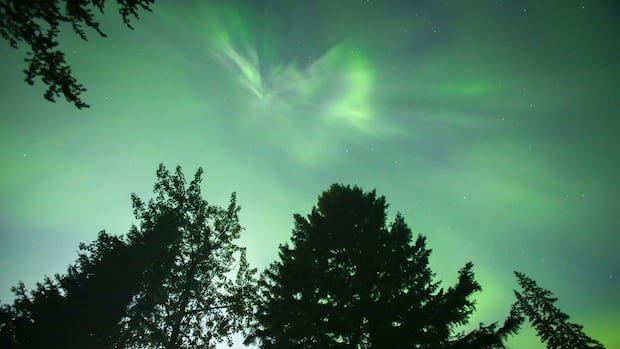

Solar storms are set to produce vibrant northern lights in various parts of Canada and the northern United States for a second consecutive night. The U.S. National Oceanic and Atmospheric Administration (NOAA) forecasts that the spectacle will be visible in a wide range of regions, including British Columbia, Alberta, Saskatchewan, Manitoba, Yukon, Northwest Territories, Nunavut, Labrador, and northern sections of Ontario and Quebec.
Shawn Dahl, a service coordinator at the Space Weather Prediction Center in Colorado, anticipates that the stunning display will continue for a significant part of the night, reaching peak intensity between 7 and 10 p.m. ET. He advises individuals planning to witness the phenomenon to stay updated with their local weather forecasts.
Recent days have seen the sun unleash several powerful solar flares, followed by coronal mass ejections (CME) – rapid particle explosions traveling through the solar wind. Two CMEs directed towards Earth arrived on Tuesday night, resulting in the aurora borealis, or northern lights, being visible as far south as New Mexico and Texas.
The Space Weather Prediction Center (SPWC) predicts that the geomagnetic storm may persist on Wednesday night and possibly into Thursday, albeit with reduced intensity. This celestial event occurs when large clouds of protons and electrons ejected from the sun interact with Earth’s magnetic field, creating the dazzling light show we observe with various colors.
To witness the ambient colors of the auroras, heading to a location with a clear view of the sky, preferably away from major light sources, is recommended by Canadian astrophysicist Dr. Jesse Rogerson. With the sun currently at the peak of its 11-year activity cycle, northern lights sightings have become more frequent and widespread, with more displays expected in the days to come.
Solar storms not only bring colorful light displays but can also have impacts on Earth, such as temporary disruptions to the power grid when fast-moving particles collide with the planet’s magnetic field. Space weather disturbances can interfere with air traffic control systems, satellite operations, and communications, with severe storms potentially causing disruptions in radio and GPS signals.
A severe solar storm in 1859 led to auroras appearing as far south as Hawaii and caused telegraph lines to catch fire in a rare occurrence. In 1972, a solar storm may have set off magnetic sea mines off the coast of Vietnam. Additionally, a significant solar storm in March 1989 caused power outages in parts of Quebec.
While solar storms cannot be predicted months in advance, space weather experts issue alerts to prepare for potential impacts in the days leading up to an expected event. For those interested in witnessing auroras, checking forecasts on the NOAA’s Space Weather Prediction Center website or aurora forecasting apps, finding a dark, quiet location away from city lights, and monitoring weather conditions are recommended. Smartphone cameras can capture auroras that may not be visible to the naked eye.