

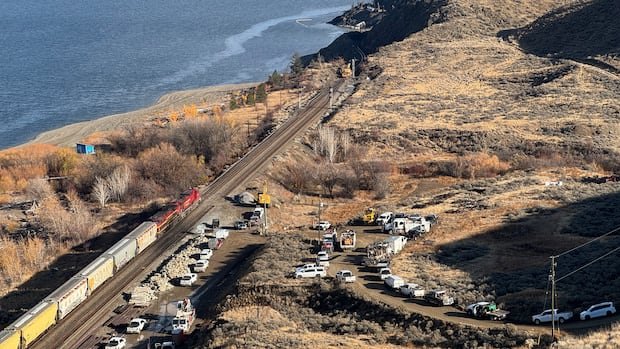

British Columbia officials have reported that initial tests indicate no contamination exceeding drinking water standards after 80,000 liters of fuel spilled into Kamloops Lake due to a train derailment. The incident involving a Canadian Pacific Kansas City (CPKC) train occurred last Saturday, resulting in approximately 80,700 liters of aviation fuel leaking into the lake as 17 rail cars derailed.
Communities like Savona, Tobiano, and Walhachin, which rely on the lake for their water supply, were immediately concerned. Following the spill, many communities ceased drawing water from the lake. However, officials confirmed on Friday that early water sample tests showed no direct impact on drinking water quality in Savona, home to around 700 residents.
The Thompson-Nicola Regional District (TNRD) is awaiting further test results and plans to update Walhachin residents accordingly. The TNRD emphasized that the risk to the Walhachin Community Water System remains minimal. Additionally, tests conducted earlier this week showed that water samples did not exceed provincial safety thresholds for drinking water or aquatic life.
Efforts are underway to remove jet fuel from the lake and a train car obstructing the tracks. Authorities are investigating the deaths of several birds, including Canada geese, near the lake to determine if they are linked to the spill. The B.C. Environment Ministry reported that a containment boom is in place on the lake to contain any visible oil sheen, with ongoing water sampling confirming that fuel levels remain below safety guidelines.
Private water operators drawing water from Kamloops Lake, such as in Tobiano, were advised to contact their operators for any concerns. Interior Health authorities recommended that Frederick residents across the lake refrain from using lake water due to potential risks. Cleanup operations are ongoing, with the CPKC obligated to remove all derailed cars from the site.
Environmental experts stress the importance of monitoring the long-term effects of the spill on downstream areas. They highlight the need for ongoing vigilance to protect the environment from such incidents, emphasizing the vulnerability of the region to pollution from various sources.