


In ancient Greece, pigeons were utilized to transmit Olympic game outcomes, as well as to transport messages across enemy lines during World War I. In British Columbia, these birds have even been involved in smuggling drugs into prisons. Recently, researchers in Vancouver have assigned a new task to pigeons – assisting in the development of more intelligent drones.
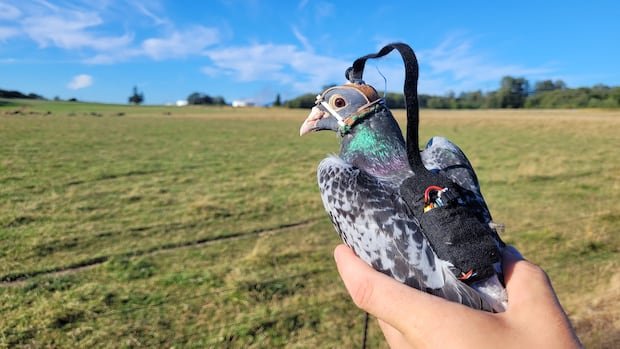
A study led by the University of British Columbia and published in Current Biology involved equipping homing pigeons with miniature backpacks containing a small computer and head-mounted cameras to observe their eye movements during flight. The entire setup, weighing around 27 grams, included a credit card-sized computer, a modified commercial camera, and sensors to monitor the birds’ movements and orientation.
Anthony Lapsansky, the researcher behind the study, mentioned the challenges faced in outfitting the pigeons with the equipment, involving extensive practice and trial and error. The pigeons were gradually accustomed to the gear by first introducing fake backpacks before adding complexity to avoid causing panic.
A flock of about 16 pigeons participated in the research, released along a familiar route to their home loft. Upon their return, the equipment was removed, and the recorded footage was retrieved for analysis.
The study revealed that pigeons exhibit slow, subtle eye movements during flight, which potentially aid in acquiring detailed information about their surroundings. Pigeons were observed turning both eyes inward while landing on a perch, suggesting a depth perception mechanism similar to humans.
Contrary to the general belief that pigeons keep their eyes fixed in place while flying, the research challenged this assumption. David Bird, a wildlife biology expert, noted that the California Institute of Technology’s recent study, which focused on short-distance flights, differed from the UBC study, which involved longer and higher-altitude flights.
The findings could influence drone design, as birds’ eye movement behaviors could inspire the development of drones with adaptive cameras for enhanced navigation and information gathering capabilities. Researchers suggest that drones with more sophisticated and adaptable cameras could significantly improve their effectiveness in various applications, such as aerial surveillance and monitoring.
The study highlights the potential of leveraging biological insights from pigeons to enhance drone technology, paving the way for more advanced and efficient drone systems in the future.