

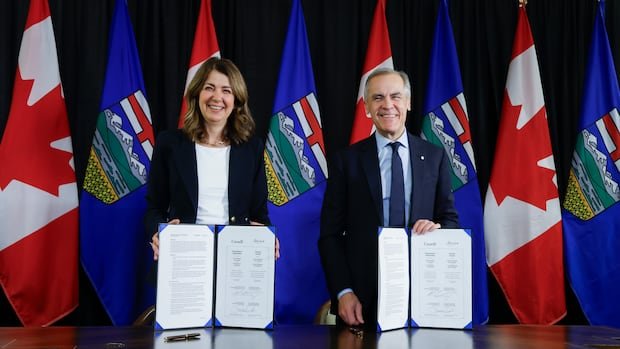

Shortly after Prime Minister Mark Carney and Alberta Premier Danielle Smith officially signed their memorandum of understanding on Thursday, Smith quipped to reporters in Calgary that she wished for pipelines to return to being uneventful. However, pipelines have historically been linked to political unrest in Canada for over seven decades. The complex issues surrounding interprovincial pipelines, such as unresolved reconciliation efforts, the ongoing challenge of climate change, and concerns about national unity, suggest that pipelines are unlikely to become mundane anytime soon.
The memorandum between Carney and Smith was never expected to make pipelines uninteresting, especially considering Quebec MP Steven Guilbeault’s resignation from the cabinet in protest, following a call to the prime minister. Guilbeault acknowledged the exceptional circumstances surrounding the memorandum, expressing support for Carney’s efforts to maintain national unity while prioritizing environmental concerns.
The memorandum addresses various critical aspects, including support from the Alberta government for enhanced pricing mechanisms for industrial emissions. This collaboration with a conservative premier on climate policy signifies a significant step for Canada’s future climate strategies. Additionally, Alberta’s commitment to achieving net-zero emissions by 2050, despite opposition from some quarters, is noteworthy.
While the agreement advances certain climate policies, it also involves sacrifices. Alberta’s exclusion from federal clean electricity regulations in exchange for industrial carbon pricing agreement could set a precedent for other provinces seeking similar exemptions. The memorandum’s linkage of the Pathways proposal to a new pipeline underscores the interdependence of energy projects in the country.
Guilbeault’s resignation amidst these developments adds a dramatic twist to the situation. His departure resonates with his complex identity within environmental and political circles, symbolizing the challenges of balancing diverse perspectives within a government. Guilbeault’s decision to join Trudeau’s cabinet despite the government’s pipeline ownership further exemplifies the nuanced nature of political decisions.
Carney’s initiative aims to usher in a new chapter in Canadian energy policy, emphasizing a different approach. Guilbeault’s exit, while potentially signaling a shift in government dynamics, underscores the ongoing challenges of managing diverse interests and navigating complex political landscapes, particularly concerning pipeline development.
In conclusion, the recent developments surrounding the memorandum of understanding highlight the intricate interplay between energy policy, environmental concerns, and political dynamics in Canada, emphasizing the complexities inherent in building consensus on crucial national issues.