

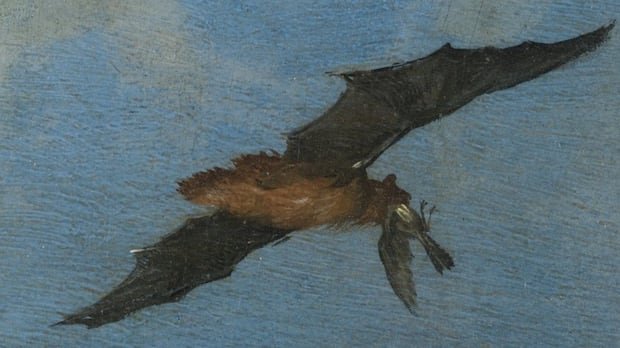


The largest bat in Europe displays an impressive skill: seizing birds while in flight and consuming them, a behavior that seems to have been recognized by a painter centuries before scientific confirmation.
Last year, researchers provided evidence of this mid-flight feeding behavior. Ecologists have now found further proof of this feeding habit concealed in a painting by the 17th-century Flemish artist Jan Brueghel the Elder.
The findings were recently detailed in the journal Proceedings of the National Academy of Sciences.
Mirjam Knörnschild, a Humboldt University animal behavior researcher, praised the study as a “clever piece of natural history detective work,” emphasizing the connection between advanced modern research techniques and historical art.
Is it Observation or Imagination?
In the painting titled Air, over 60 bird species are depicted alongside three bat species. In one corner, researchers, including Miguel Clavero, identified what appears to be a large noctule bat with a songbird in its mouth.
Clavero, an ecologist with the Spanish National Research Council, sought the expertise of a bat researcher as he initially aimed to identify all animals depicted in the painting.
The quest to validate the greater noctule bats’ ability to catch and consume birds began in 2001 when researchers found bird feathers in bat feces, suggesting a preference for larger prey. Last year, researchers confirmed the behavior through sophisticated methods involving tracking devices on bats.
Clavero believes that while Brueghel may have been aware of the bats’ hunting behavior, it is unlikely he witnessed it firsthand, with the behavior typically occurring at night and at high altitudes.
While some experts argue that the painting may have been inspired by real natural history knowledge, others suggest it could be part of the artist’s imaginative creations.
Regardless of the debate, the discovery in the painting indicates potential for uncovering more wildlife insights from historical art, according to ecologist Danilo Russo from the University of Naples Federico II.
Russo highlights the importance of exploring historical biodiversity and the hidden natural history that may still be waiting to be revealed in historical sources.
Discoveries like these challenge us to rethink historical perspectives on biodiversity and inspire further exploration of historical sources for hidden natural history gems.