

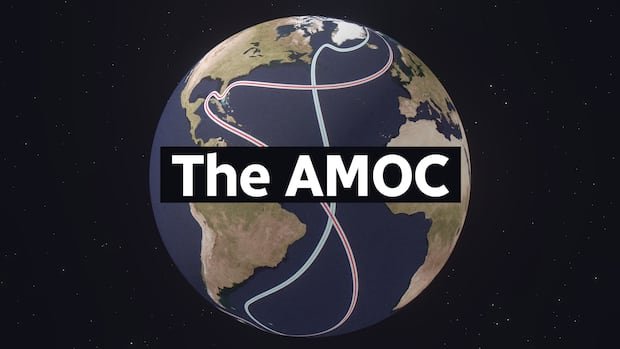

In the movie “The Day After Tomorrow,” there was a portrayal of a global catastrophe where the planet faced an ice age due to a shutdown of the Atlantic Meridional Overturning Circulation (AMOC). While the movie was fictional, the underlying cause of the climate shift was scientifically based. Scientists are now expressing growing concerns about the slowing down of the AMOC, its potential tipping point, and the resultant global ramifications.
The AMOC is a crucial component of the global ocean current system, acting as a conveyor belt that transports warm surface water into the North Atlantic, where it sinks into the deep ocean before returning southward. This circulation of heat, water, and carbon plays a vital role in regulating global weather patterns and supporting marine ecosystems. Although an AMOC shutdown would not lead to the extreme deep freeze seen in “The Day After Tomorrow,” the repercussions on a global scale would be severe and extensive.
Recent research, such as a study from the University of Miami analyzing data from different locations in the Atlantic, including the Scotian Shelf near Nova Scotia, has revealed that the AMOC has already slowed by 10 to 20 percent over the past two decades. Professor Stefan Rahmstorf from the Potsdam Institute for Climate Impact Research in Germany, who has been studying the AMOC for decades, highlights that the slowing down of the circulation has long been anticipated by climate models.
The study also predicts that the AMOC system could slow by 51% by 2100 under a mid-range greenhouse gas emissions scenario. This potential slowdown poses significant risks, impacting global agriculture, food production, climate, weather patterns, and sea levels. The study suggests that the more pessimistic models predicting a greater weakening of the circulation by 2100 align more closely with observational data, indicating a concerning trend.
The consequences of a further slowdown or shutdown of the AMOC could include intensified winter storms, altered marine ecosystems, and rising sea levels along the North Atlantic shores. Douglas Wallace, a professor of Oceanography at Dalhousie University, emphasizes the need for comprehensive research to prepare for the impending changes. Both Wallace and Rahmstorf stress the importance of immediate action to mitigate the risks associated with AMOC disruption by adhering to international agreements like the Paris Climate Accord and transitioning away from fossil fuels.