

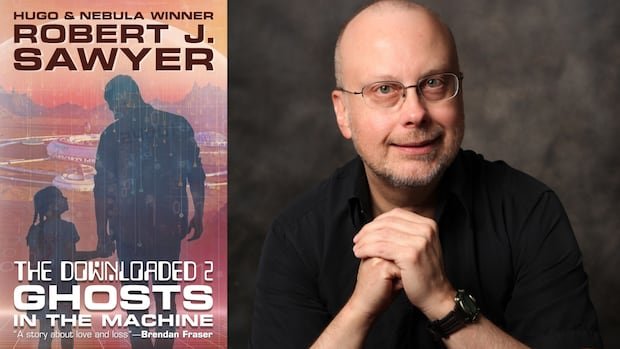

Renowned science fiction author Robert J. Sawyer is deeply passionate about his craft, as reflected in his personalized license plate that proudly proclaims him as an “SF Writer.” However, when faced with a daunting diagnosis of incurable cancer, Sawyer feared that the treatment, known for causing cognitive impairment, would hinder his ability to continue writing.
Expressing his concerns on a segment of Bookends with Mattea Roach, Sawyer confessed, “Being a writer is not just a profession but a source of immense joy for me. Losing that identity felt like losing a part of myself.” Nevertheless, through introspective discussions with loved ones, he realized that his worth transcended his role as an author.
Gratefully, Sawyer managed to achieve remission without experiencing cognitive decline and has since penned two additional books. In his latest work, The Downloaded 2: Ghosts in the Machine, Sawyer explores profound existential inquiries inspired by his battle with mortality. The novel delves into a futuristic realm where individuals can transfer their consciousness into a computer while their physical bodies remain in cryogenic stasis.
During his appearance on Bookends, Sawyer delved into the philosophical underpinnings of his science fiction narratives, shedding light on his belief in the interconnectedness of science and spirituality. Reflecting on the intertwining themes of consciousness, mortality, and identity, Sawyer shared his longstanding fascination with these concepts, which predates his personal confrontation with such existential questions.
Despite undergoing cancer treatment, Sawyer remained resolute in his commitment to his humanity, emphasizing his lack of desire to transcend his homo sapiens essence. By weaving his own health struggles into his literary creations, such as attributing a character in his novels with his own cancer diagnosis, Sawyer explored profound existential dilemmas within the confines of fiction that mirrored his real-life reflections.
Moreover, Sawyer highlighted the parallels he draws between advanced technology and spiritual mysticism, rejecting the notion that science and religion exist in separate spheres. Drawing from his acclaimed novel The Terminal Experiment, where he tackled the contentious topic of scientific evidence for the existence of a divine entity, Sawyer emphasized his longstanding engagement with the discourse on science and religion.
Championing the fusion of philosophical inquiry with storytelling, Sawyer challenged the misconception that science fiction dismisses profound existential questions, asserting that the genre can provide a platform for thought-provoking contemplation. Embracing the enduring human inclination towards spirituality, Sawyer underscored the implausibility of a future devoid of the spiritual and the supernatural, advocating for a nuanced perspective that respects diverse beliefs.
In his prolific career, Sawyer’s thought-provoking narratives have garnered critical acclaim and sparked meaningful dialogues on the intersection of science, philosophy, and faith. Through his unwavering dedication to exploring the profound mysteries of existence, Sawyer has established himself as a leading voice in the realm of speculative fiction, inspiring readers to contemplate the boundless possibilities of the human experience.