

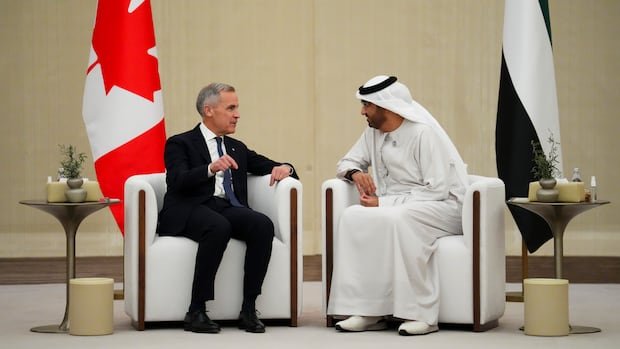

Prime Minister Mark Carney has revealed that Ottawa is actively engaged in a $1-billion initiative to enhance the processing capacity of critical minerals in Canada, with an additional investment commitment of approximately $70 billion from the United Arab Emirates. Carney’s statements were made following his trip to Abu Dhabi, where trade discussions took precedence amid ongoing concerns over the situation in Sudan.
During a speech to the Canada-U.A.E. Business Council, Carney expressed his satisfaction with the progress of an agreement valued at over $1 billion, emphasizing its significance in expanding Canada’s critical minerals processing capabilities. This development is expected to generate employment opportunities, bolster the long-term mineral supply crucial for energy technologies and advanced manufacturing.
Highlighting the economic growth and societal advancement implications of the new project, Carney stressed Canada’s leadership in artificial intelligence, quantum technologies, and life sciences. Acknowledging the need to capitalize on these strengths for the betterment of humanity, he emphasized the importance of commercializing these innovations.
Carney extended a personal invitation to Emirati investors to explore potential collaborations on transformative projects in Canada, following the recent signing of an investment-protection pact and the initiation of trade discussions. He affirmed that the U.A.E. had committed to investing $70 billion in Canada to support various sectors, including energy, artificial intelligence, logistics, and mining.
Despite the absence of an official announcement from the U.A.E. foreign ministry, media reports suggest that the funding will be channeled into strategic industries within a framework agreement for bilateral investments. Carney’s office underscored the investment as a vote of confidence in the Canadian economy, which has been navigating challenges such as the U.S. trade dispute and productivity issues.
Expressing his strong belief in the potential for expanded trade relations between Canada and the U.A.E., Carney articulated his confidence in doubling bilateral trade within less than a decade. He emphasized the alignment between the two nations as key trading entities and energy leaders transitioning towards green initiatives.
Looking ahead to future collaborations, Carney outlined plans for a trade mission to the U.A.E. in the upcoming year, focusing on artificial intelligence, energy, and agriculture. He characterized the visit as the start of a new chapter in bilateral relations, marking a significant milestone as the first visit by a sitting Canadian prime minister since 1983.
Addressing concerns over the Sudan civil war, Carney disclosed discussions with U.A.E. President Sheikh Mohamed bin Zayed Al Nahyan, emphasizing the importance of peace efforts in Sudan. While refraining from attributing blame regarding alleged support for the Rapid Support Forces militia, Carney highlighted dialogues on peace initiatives aligned with President Trump’s efforts.
Carney’s remarks to potential investors preceded his departure for the G20 summit in Johannesburg, where the absence of senior American officials has been noted due to the Trump administration’s stance on anti-white violence in South Africa. Canada’s G20 priorities include enhancing critical mineral supply chains, leveraging artificial intelligence for sustainable development, disaster prevention, global development funding reforms, and promoting gender equality through economic growth.