

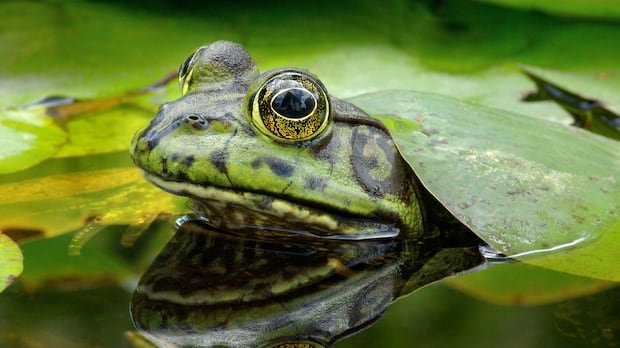

Residents in the Comox Valley on Vancouver Island are uniting to eradicate invasive American bullfrogs from local lakes and waterways. The Tsolum River Restoration Society is launching workshops to assist individuals in setting up traps for bullfrog tadpoles, citing the threat these large bullfrogs pose to indigenous species.
American bullfrogs, known to grow twice the size of other frogs in British Columbia, have a voracious appetite, preying on various species such as frogs, salamanders, insects, and even small mammals and reptiles. One resident diligently checks his tadpole traps at Maple Lake every two days to safeguard the fragile ecosystems.
Bruce Moffat, a volunteer with the society, initially adopted a “live and let live” approach towards bullfrogs until he encountered a proliferation of invasive tadpoles at Maple Lake. Recognizing the potential harm to local wildlife, Moffat and other advocates are now actively involved in removal efforts.
Moffat emphasizes the detrimental impact a thriving population of American bullfrogs can have on local amphibians, fish, and insects, subsequently affecting larger species like birds. The Invasive Species Council of British Columbia warns that these bullfrogs jeopardize at-risk species such as the northern red-legged frog and the western painted turtle.
Gail Wallin, the executive director of ISCBC, stresses the importance of controlling bullfrog populations, as eradicating them entirely may be unfeasible. Wallin encourages documenting bullfrog activity and implementing measures like trapping and euthanizing them safely to manage their numbers.
The Tsolum River Restoration Society is conducting workshops in the Comox Valley to educate residents on constructing and using tadpole traps, aiming to empower the community to combat the invasive species. These traps are cost-effective and designed to attract and temporarily trap bullfrog tadpoles, aiding in population control efforts.
Katie Gair, the project coordinator at the society, highlights the distinctive features of bullfrog tadpoles, emphasizing the need to distinguish them from native species based on their appearance. Removing bullfrogs forms part of a comprehensive strategy to safeguard local species, with community involvement crucial for long-term conservation efforts.