

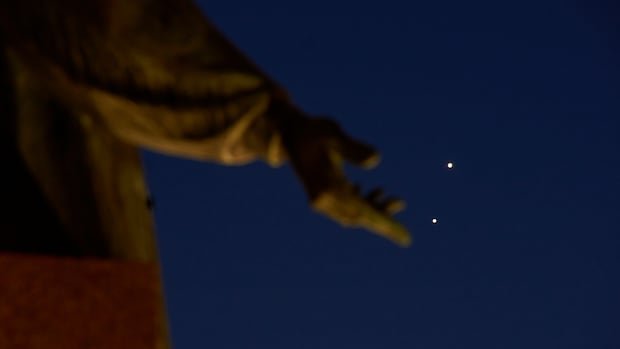

In the western sky after sunset, two bright celestial objects resembling stars are actually the planets Jupiter and Venus. Despite appearing close together, they are actually around 670 million kilometers apart. Venus has been steadily ascending in the sky since early May, while Jupiter has been descending westward.
To observe this planetary pair, look towards the west after dusk with Venus being the brighter and lower celestial object. These planetary conjunctions serve as a reminder of the dynamic nature of space, showcasing the movement of solar system objects on a daily basis.
As Venus and Jupiter approach each other, Venus will pass Jupiter and ascend higher in the sky. The closest encounter between the two will occur on June 8 when they will be slightly over a degree apart, with an even closer alignment on June 9. Such celestial meetings are termed appulses or conjunctions.
Rather than waiting for their closest approach, observers can track the planets’ movement across the sky in the upcoming days with a clear view of the western horizon. Additionally, Mercury will also join the planetary duo on June 8 and 9 as it emerges higher above the sun’s glare.
Noteworthy is the rapid motion of Jupiter’s four brightest moons – Io, Callisto, Europa, and Ganymede. These moons orbit Jupiter swiftly, allowing their positions to change noticeably from one night to the next. On June 1 at 9:30 p.m., Io, Callisto, and Europa will be positioned to the left of Jupiter, while Ganymede will be on the right. By observing the following night at the same time, only Callisto will be on the left, with Io and Ganymede behind Jupiter and Europa passing in front.
Skywatchers can use tools like Sky & Telescope’s Jupiter Moons tool or night sky apps to identify and track celestial objects in the sky.