

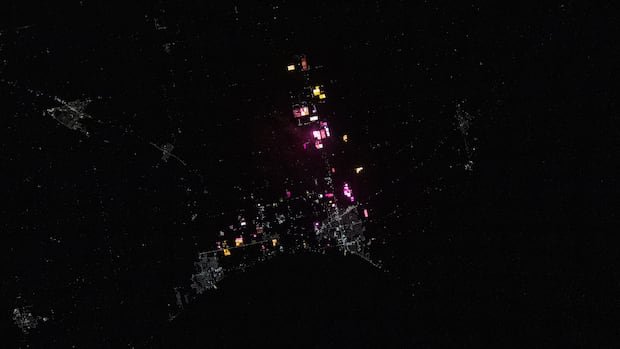

In southwestern Ontario, the radiant glow of hot pink and canary-colored lights emanating from the greenhouses is so vivid that it can be captured by astronauts from space. These colorful lights, fixed atop the largest cluster of greenhouses in North America, have revolutionized both the night sky in the region and the province’s agriculture industry, valued at billions of dollars.
In recent years, numerous vegetable and cannabis producers have integrated thousands of lights inside greenhouses in Leamington and Kingsville, Ontario, to enable year-round plant growth. The luminous spectacle from this southern Canadian region, visible as far as Michigan, has elicited a mix of wonder and concern, leading local communities to implement regulations limiting greenhouse light emissions during nighttime.
Richard Lee, the executive director of the Ontario Greenhouse Vegetable Growers, acknowledges that the rapid advancement of lighting technology posed challenges in responding to and addressing perceived light pollution issues. Despite the enforcement of rules to minimize light spillage, the vibrant glow remains visible across the region and even from the International Space Station.
The expansion of greenhouses in Kingsville and Leamington, as indicated by recent satellite images from NASA, has been substantial since 2015. This growth surge is partly attributed to Canada’s legalization of marijuana and the adoption of advanced lighting systems for year-round plant cultivation, contributing to the sector’s upsurge.
The demand for fresh produce, particularly amid the disruptions in the supply chain caused by the COVID-19 pandemic, has also played a significant role in driving greenhouse expansion. This demand has propelled commercial greenhouses to cultivate various crops such as tomatoes, cucumbers, peppers, and strawberries, ensuring ample yield and boosting local food security and economic stability.
In response to ecological concerns raised by the community, both Kingsville and Leamington have implemented bylaws in recent years to tackle the escalating greenhouse light pollution. These regulations aim to curtail light emissions and maintain the unique ecosystems and migratory pathways of birds and monarch butterflies in the region.
Efforts to enforce these bylaws have seen mixed results, with Kingsville intensifying enforcement actions, while Leamington has reported fewer complaints related to greenhouse lighting. However, challenges persist in achieving full compliance due to practical considerations like ventilation requirements within the greenhouses.
William Lubitz, an engineering professor at the University of Guelph, emphasized that the effectiveness of light abatement measures can be influenced by factors like weather conditions, the brightness of the moon, and human eye adaptability. Despite efforts to minimize light emissions, the glow from greenhouses can still appear bright under certain circumstances, impacting the surrounding environment.
Overall, the balance between mitigating light pollution and fostering agricultural growth remains a critical issue for greenhouse operators and local authorities, highlighting the ongoing challenge of harmonizing economic development with environmental sustainability.